
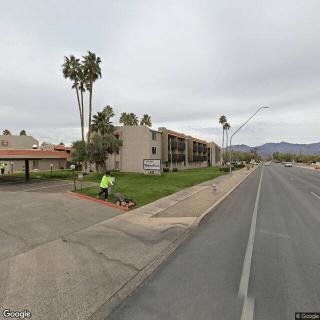
4654 S 16th Ave, Tucson, AZ 85714
To contact a resident: (520) 882-2882
For more information about senior living options: (866) 208-4318
Mountain Trace Terrace Costs & Pricing
Mountain Trace Terrace offers competitively priced accommodations that stand out in comparison to broader market rates within Pima County and the state of Arizona. For instance, a studio apartment at Mountain Trace Terrace is available for $665 per month, significantly lower than the county average of $3,786 and the state average of $3,829. Similarly, a one-bedroom unit is priced at $719, again well below the county's average of $3,660 and slightly above the state's average of $3,532. The two-bedroom options also reflect this trend, with a cost of $863 compared to Pima County's average of $3,974 and Arizona's prevailing rate of $4,106. These figures clearly indicate that Mountain Trace Terrace provides an affordable alternative without compromising on quality or comfort.
| Floor plans | Mountain Trace Terrace | Pima County | Arizona |
|---|---|---|---|
| Studio | $665 | $3,786 | $3,829 |
| 1 Bedroom | $719 | $3,660 | $3,532 |
| 2 Bedrooms | $863 | $3,974 | $4,106 |
Senior living communities with a similar price nearby
-
from -$54 / mo

Broadway East Apartments
$611 / month8.1 miles away -
from -$54 / mo
Wilmot North Apartments
$611 / month8.4 miles away
Overall Review of Mountain Trace Terrace
Pros
 The tour was good.
- The representative was thorough.
Cons
 They were too expensive for the reviewer's budget.
- The price was beyond what they could afford.
Review
Mountain Trace Terrace in Tucson, AZ is best suited for seniors and families who prize a thorough, transparent admissions experience and insist on clarity around services and costs before making a commitment. The community presents itself as a place where questions are welcomed and explanations are thorough, and that approach is especially valuable for households that want to move forward with confidence rather than guesswork. Those who already know they can accommodate an upfront price point and are evaluating options against a concrete budget will find the initial discovery process reassuring rather than opaque.
That said, alternatives should be on the table for anyone working within a tighter budget. The sole recent feedback notes that Mountain Trace Terrace was beyond the reviewer’s means, a reality that cannot be ignored by price-conscious families. When affordability is non-negotiable, it makes sense to compare base rates, what’s included by default, and what services carry extra charges across several communities. Potential residents should also consider whether there are more flexible pricing structures or tiered care options elsewhere that better align with long-term financial planning.
The principal strength here lies in the tour and the staff’s thoroughness. A well-executed tour that lays out daily life, care pathways, and cost structure in practical terms reduces the risk of post-enrollment surprise and helps families envision how life would unfold. This is not merely ceremonial; it translates into actionable clarity about what residents will experience, how staff respond to changing needs, and how the environment supports day-to-day routines. For decision-makers who distrust vague promises, that level of candor in the discovery phase can be a decisive advantage.
But the main con, the price point, will shape whether those strengths translate into a viable choice. When affordability is the limiting factor, even excellent introductions and clear expectations may not suffice. The affordability question becomes the lens through which every other attribute is weighed. Prospective residents should relentlessly quantify what is included at the stated price, what would incur incremental charges, and how costs might evolve if care needs intensify. For families facing prolonged occupancy, the long-term cost slope matters as much as the sticker price shown at admission.
The payoff of Mountain Trace Terrace’s positives hinges on alignment between budget and expectations. For households that can absorb the cost and value a disciplined, informative onboarding, the experience can justify the premium by reducing risk, accelerating adjustment, and providing a reliable framework for later decisions about escalating care. In contrast, for those whose financial plan permits only careful, conservative spending, the current price structure diminishes the practical gains offered by a well-executed tour. In short, excellent admissions engagement is meaningful, but it is not a substitute for sustainable affordability.
For families actively evaluating options, the recommended path is concrete and disciplined. Request an itemized, all-inclusive pricing sheet and a clear delineation of what services require extra payments. Collect and compare sample contracts, including escalation paths for changing care levels, so the predictability of costs can be tested against real needs. Visit multiple communities to observe how the tour-to-day-life transition feels in practice, and measure how well each environment supports ongoing independence while providing predictable, transparent pricing. Mountain Trace Terrace deserves serious consideration for those who can justify the investment, while others should widen the search to communities with more budget-friendly combinations of care quality and total cost of care.
 Active Adult Communities (55+)
 Cats allowed
 Dogs allowed
 Activities off-site
 Devotional services off-site
 Indoor common areas
 Outdoor common areas
 Wheelchair accessible showers
 Tucson International (4 miles away)




 6 Crucial Ways an Elder Law Attorney Assists Families
 Navigating the Tax Landscape of Caregiving: Credits, Deductions, and Beyond
 Highly Beneficial Low-Impact Exercises for Senior Living Residents