Overall Review of Legacy Post-Acute Rehabilitation
common15 reviews mention this
Staff compassion and support stand out
Residents and visitors frequently describe genuinely caring, responsive staff members.
Many reviews focus on staff members being kind, professional, and attentive, with several people saying the team treats residents with dignity and families with clear communication. A number of residents or visitors also mention feeling listened to and supported during visits, including after care concerns. There are also a few strongly negative reviews about staff walking past residents or not following through on basic needs, but the more common theme is overall compassion.
common10 reviews mention this
Cleanliness is mentioned both ways
Some reviewers say the facility feels clean and well kept, while others report unsanitary conditions.
On the positive side, multiple reviews describe the building as clean, tidy, and well maintained, including rooms and common areas. At the same time, several critical reviews describe unpleasant odors and unclean conditions, including reports of urine and feces present and concerns about sanitation. Overall, cleanliness shows up as a major point of contrast between reviewers.
caveat5 reviews mention this
Understaffing and slow responses
A recurring complaint is inadequate staffing and delayed help when needed.
Several low-rating reviews say the facility is understaffed and overcrowded, with reports of employees not checking on patients as often as needed. Two reviews specifically mention trouble with the call button experience, describing long waits or communication problems when help was requested. There are also claims that residents did not receive consistent basic care, which ties into the broader theme of staffing and responsiveness.
caveat6 reviews mention this
Odor and sanitation concerns recur
Multiple reviews describe strong urine or feces odors and related sanitation problems.
Critical reviews repeatedly bring up unpleasant smells, often describing urine and feces odors, and connecting them to how well residents are being cared for and cleaned. A few reviews also describe conditions such as soiled diapers or delayed changes, which reinforces the sanitation concern beyond just the odor itself. While some reviewers say the environment is clean and safe, the odor theme is one of the most consistent negatives in the feedback.
caveat2 reviews mention this
Food quality and diabetes support
Some reviewers question the way meals fit diabetes needs.
A couple of reviews mention dietary concerns tied to diabetes, including reports of receiving desserts or other high-carb items despite a diabetic diet. Other comments describe overall food as unpleasant, though not all reviewers address diet specifically. This points to mixed experiences with meal quality and how well diabetes-related needs are handled.
How we summarize
Counts show how many written reviews mention each theme; a review can touch several themes, and only frequently mentioned themes are displayed.
Features
Housing
119 resident community capacity
Types of Care
Skilled Nursing Facility
Amenities
Air-conditioning
Beauty salon
Cable or satellite TV
Computer center
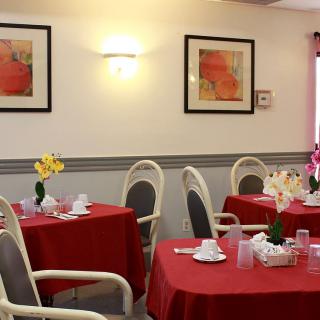
Dining room
Fitness room
Fully furnished
Gaming room
Garden
Housekeeping services
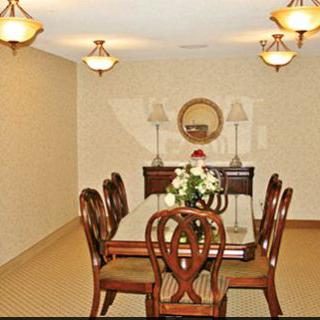
Kitchenette
Move-in coordination
Outdoor space
Private bathrooms
Restaurant-style dining
Small library
Telephone
Wellness center
Wi-Fi/high-speed internet available
Transportation
Ontario International (19 miles away)
Community operated transportation
Transportation arrangement
Transportation arrangement (non-medical)
Transportation to doctors appointments
Care Services
12-16 hour nursing
24-hour call system
24-hour supervision
Activities of daily living assistance
Assistance with bathing
Assistance with dressing
Assistance with transfers
Diabetes diet
Meal preparation and service
Medication management
Mental wellness program
Special dietary restrictions
Dining
Diabetes diet
Special dietary restrictions
Activities
Community-sponsored activities
Concierge services
Fitness programs
Planned day trips
Resident-run activities
Scheduled daily activities
Nearby Places of Interest
Hospitals
San Bernardino Medical Group (0.4 miles)
Vantage Oncology (0.8 miles)
Pacific Park Convalescent Center of San Bernardino (2.7 miles)
Mountain View Surgery Center (4.7 miles)
Loma Linda Ambulatory Care Center (5 miles)
Jerry L Pettis Memorial (5.4 miles)
Pharmacies
Family Pharmacy (0.4 miles)
Diamond Collective 20 Cap (0.9 miles)
Don's Drugs (2.2 miles)
Cbc Community Pharmacy (2.4 miles)
CVS Pharmacy (2.5 miles)
Rite Aid (3.1 miles)
Caremark Rx (4.5 miles)
Physicians
San Bernardino Eye Specialists (0.6 miles)
Palm Imaging Institute (0.7 miles)
California Eye Specialists (0.8 miles)
Primary Care Medical Group of Inland Empire (0.9 miles)
Jo David DDS (0.9 miles)
Bolivar Family Medical Clinic (1.5 miles)
Yukom Patient Group (2 miles)
Cafes
Viva La Boba (1.5 miles)
Starbucks (1.9 miles)
Starbucks (3.9 miles)
Starbucks (5.5 miles)
Stell Coffee & Tea Company (6.6 miles)
Theaters
Regal San Bernardino & RPX (1.5 miles)
Mountain Grove 16 (5.4 miles)
Restaurants
In-N-Out Burger (1.7 miles)
Amapola Rico Taco (2 miles)
Serrano Vista Cafe (3.3 miles)
Rock & Brews (3.3 miles)
George Lopez’s Chingon Kitchen (3.3 miles)
Orchid Thai Restaurant (3.9 miles)
In-N-Out Burger (4.1 miles)
Transportation
San Bernardino Transit Center (2 miles)
The Colton Diamonds (4.8 miles)
Places of Worship
Crosswalk Church (4.7 miles)
Packinghouse Church (5 miles)
National Association of Seventh Day Adventist Dentists (5.1 miles)
Azure Hills Seventh-Day Adventist Church (6.5 miles)
The article explores the complexities of using Social Security to finance long-term nursing home care in the U.S., detailing eligibility requirements and misconceptions, while emphasizing that these benefits often do not cover full costs and highlighting the need for strategic financial planning and professional guidance.
Pneumonia significantly affects older adults due to weakened immune systems and atypical symptoms that complicate diagnosis, necessitating early detection and tailored treatment. Risk factors include chronic diseases and cognitive impairments, with preventive measures like vaccinations and healthy lifestyles being crucial for reducing risk.
Palliative care enhances the quality of life for seriously ill patients by providing comprehensive support at home through a multidisciplinary team, addressing various needs and prioritizing comfort over curative treatments. While it offers personalized care and involves family in decision-making, challenges like caregiver stress and logistical issues persist, with growing demand prompting advancements in technology and healthcare policies to improve access.
Get PricingAsk A QuestionSchedule A TourContact Senior Advisor
By clicking submit, you agree to our Partner's Terms of Use. You
also consent to receive calls and texts, which may be autodialed, from our Partner. Your consent is not a condition to
using our Partner's service. Please visit our Partner's Privacy Policy for information about their privacy practices.


 119 resident community capacity
 Skilled Nursing Facility
 Air-conditioning
 Beauty salon
 Cable or satellite TV
 Computer center
 Dining room
 Fitness room
 Fully furnished
 Gaming room
 Garden
 Housekeeping services
 Kitchenette
 Move-in coordination
 Outdoor space
 Private bathrooms
 Restaurant-style dining
 Small library
 Telephone
 Wellness center
 Wi-Fi/high-speed internet available
 Ontario International (19 miles away)
 Community operated transportation
 12-16 hour nursing
 24-hour call system
 Activities of daily living assistance
 Assistance with bathing
 Assistance with dressing
 Assistance with transfers
 Diabetes diet
 Medication management
 Mental wellness program
 Special dietary restrictions
 Concierge services
 Planned day trips
 Strong access to healthcare, dining, and transportation nearby.


 Financing Long-Term Nursing Home Care Through Social Security: A Thorough Exploration
 Essential Knowledge on Pneumonia in Older Adults
 Exploring Palliative Care in the Home: A Comprehensive Overview