

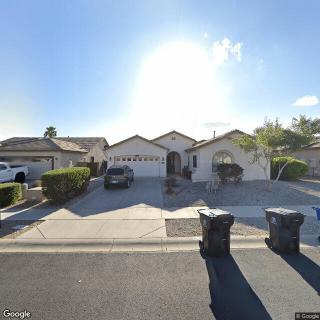
4935 W Buckskin Trail, Glendale, AZ 85083
To contact a resident: (623) 466-8319
For more information about senior living options: (866) 208-4318
Iron Springs A L H Costs & Pricing
Iron Springs A L H offers competitive pricing for assisted living services, particularly when compared to the averages within Maricopa County and the state of Arizona. With monthly costs of $2,000 for a semi-private room and $2,500 for a private room, residents can take advantage of significant savings - around $800 less for a semi-private room than the county average and approximately $800 less for a private room. This positions Iron Springs A L H as an attractive option for families seeking quality care without the higher price tag often associated with similar facilities in the region.
| Floor plans | Iron Springs A L H | Maricopa County | Arizona |
|---|---|---|---|
| Semi-Private | $2,000 | $2,801 | $2,820 |
| Private | $2,500 | $3,318 | $3,345 |
Senior living communities with a similar price nearby
-
About the same

Garcia's Assisted Living Home LLC
$2,000 / month22.7 miles away -
About the same
All Stars Assisted Living
$2,000 to $2,500 / month16.6 miles away -
About the same

Genesis Assisted Living Care Home
$2,000 to $2,500 / month12.4 miles away -
from +$200 / mo

Bent Tree Assisted Living
$2,200 to $3,200 / month5.8 miles away -
from +$300 / mo

Crystal Rose Assisted Living Home
$2,300 / month12.2 miles away
Overall Review of Iron Springs A L H
Pros
 Iron Springs is described as the best among regenerative pasture-raised, grass-fed, and grass-finished meats.
- The meats—ground beef, chuck roast, bottom round roast, beef shank, and a whole chicken—are tender and easy to slow cook, with flavorful meat broth.
- Their slow-cooked whole chicken yields a gelatinous, flavorful broth.
- The picanha grilled over an open fire was perfect.
- The grass-fed meats are great.
- The market setup in Flagstaff is friendly and professional, and they seem to be doing it right.
Review
Iron Springs A L H in Glendale, AZ is best suited for seniors who prize culinary quality and nutrition as a daily anchor. The reviews consistently spotlight meat that is sourced with care, grass-fed, pasture-raised, and finished in ways that yield tenderness and depth of flavor. For residents who equate dining with comfort, nutrition, and a sense of occasion, this community signals that meals will be a reliable, restaurant-caliber strength rather than an afterthought. The testimonials describe meals that are easy to prepare, deeply satisfying, and built around simmered broths and well-textured proteins, suggesting a kitchen culture that treats cooking as a core service rather than a peripheral amenity. In other words, food-savvy seniors will feel listened to and well fed.
Those who may want to consider alternatives are seniors who need more explicit, transparent information about medical care, staffing, and daily activities. The available reviews focus on the quality of meat and meal preparation, not on care levels, safety protocols, supervision, mobility assistance, memory care options, or how day-to-day life is structured. Prospective families seeking a comprehensive picture of caregiving capabilities or a robust activity calendar should pursue additional sources of evidence. Without firsthand confirmation of care staffing ratios, emergency response, or personalized care plans, it’s prudent to compare with communities whose care metrics are front-and-center in their reviews and tours.
The strongest pros center on culinary excellence and kitchen execution. The material points to consistently high-quality ingredients and confident cooking methods, ground beef, roasts, whole chickens, and outcomes that include tender textures and richly flavored broths. The prospect of a kitchen that can deliver such results at scale is a meaningful differentiator for any senior who values meals as a daily highlight rather than a routine obligation. A second practical plus is the impression of a professional, well-organized marketplace presence, which hints at reliable sourcing and a disciplined approach to food service. For families prioritizing nutrition and flavor, these advantages carry substantial weight.
Nonetheless, the main cons are external to the kitchen. There is a conspicuous absence of detailed information about caregiving capabilities: staff availability, caregiving training, response times, social programming, safety features, and the specific types of assistance offered (memory care, mobility support, medication management). The reviews do not illuminate licensing status, incident history, or daily life logistics, which are essential factors in choosing any assisted living option. This gap means that even standout culinary quality can’t fully compensate for uncertainty about how well the community meets broader senior-living needs. The risk is choosing based on taste alone when care requirements may outgrow what the setting clearly demonstrates.
The culinary strengths do offset some concern, but only to a point. For families where the priority is a richly prepared, nutritionally focused menu, the reported outcomes suggest a meaningful upside that can undergird overall satisfaction and quality of life. However, the absence of explicit care metrics means the decision must rest on a broader due diligence plan. Potential residents should not rely on meals alone; they should verify care capabilities through direct tours, conversations with the dietary and caregiving leadership, and through references who can attest to daily routines, safety practices, and responsiveness. In this sense,Iron Springs A L H is a compelling option for food-centric seniors, yet requires careful corroboration on care dimensions before committing.
Actionable next steps are clear. Schedule a guided tour focused on the care continuum: ask to meet the director of dining as well as the executive director of resident services; request sample menus that feature grass-fed or pasture-raised options, and inquire about how meals adapt to dietary restrictions or progressive care needs. Verify state licensing and ask for recent inspection reports and staff-to-resident ratios. If possible, speak with current residents or families about daily life, activities, and how meal times interact with social opportunities. When care clarity aligns with the kitchen’s demonstrated strength, the fit becomes strong; when it does not, alternatives with transparent care metrics should be compared.
 Board and Care Home
 Dogs allowed
 Activities on-site
 Indoor common areas
 Outdoor common areas
 Private
 Respite or short term stays offered
 Wheelchair accessible showers
 Phoenix Sky Harbor International (21 miles away)
 Diabetic care
 High acuity care
 Kosher


 Understanding Hospice Care at Home: Comprehensive Services, Key Benefits, and Eligibility
 Understanding the Full Cost of 24/7 In-Home Care: A Detailed Overview
 Exploring the World of Home Health Nurses: Qualifications, Roles, and Hiring Tips