

885 Hwy 178 E, Holly Springs, MS 38635
To contact a resident: (662) 551-1122
For more information about senior living options: (866) 208-4318
Christopher Manor Assisted Living Home Costs & Pricing
At Christopher Manor Assisted Living Home, the monthly costs for living arrangements present a competitive option in comparison to both Tate County and the state of Mississippi. For a one-bedroom unit, residents can expect to pay $3,200, which is notably lower than the average rates in Tate County at $3,323 and across Mississippi at $3,416. This pricing strategy highlights Christopher Manor's commitment to affordability without compromising on quality care. Additionally, for those considering semi-private accommodations, the cost aligns with Tate County's rate of $3,390 while surpassing the more economical average of $3,189 observed throughout the state. Overall, Christopher Manor provides an appealing balance of cost-effectiveness and quality service within a thriving community context.
| Floor plans | Christopher Manor Assisted Living Home | Tate County | Mississippi |
|---|---|---|---|
| 1 Bedroom | $3,200 | $3,323 | $3,416 |
| Semi-Private | $3,390 | $3,390 | $3,189 |
Memory care communities with a similar price nearby
-
About the same
Schilling Gardens and The Arbors
$3,250 to $4,050 / month24.8 miles away
Overall Review of Christopher Manor Assisted Living Home
Pros
 The staff has been phenomenal with how they treat my father with respect and care while giving him the freedom to make choices in his last years of life.
- Dad has begun making friends and opening up some, which is not like him; he's such an introvert.
- The leadership of the facility always tries to help where they can to make transitions as smooth as possible, and goes the extra mile to do little things.
- The facility is more like his simple home, quaint, and with things closer by for his comfort level in the room.
- The cost is reasonable, and the facility is cost-efficient for the family.
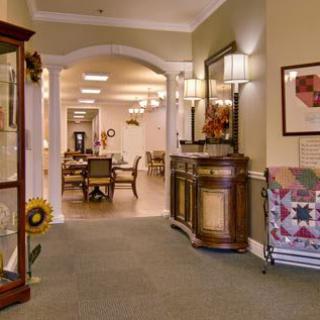
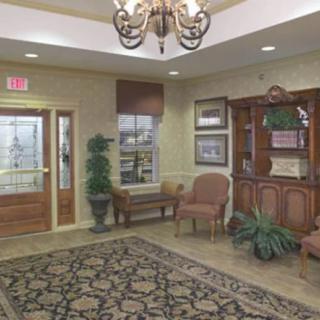
- The facility was nicely laid out, clean and offered many amenities for comfort and interaction.
- The friendly and courteous staff seemed glad to work there.
Cons
 The residents are allowed to wander into each other’s rooms and take things, a problem that has not been resolved because the halls are not monitored.
- There is a urine odor in the hall and room, and it can be overpowering.
- The odor was in the room before it was occupied.
- It is very frustrating to visit and see items missing only to be found in someone else’s room.
- Elder care is expensive.
- Dad doesn’t always enjoy the food.
Review
Christopher Manor Assisted Living Home in Holly Springs, MS is best suited for seniors who want a small, home-like setting where staff can know residents well and respond quickly. This community particularly serves memory-impacted seniors who benefit from a calm, simple environment, reduced risk of getting lost, and care teams that emphasize respect and autonomy in daily choices. Families seeking a budget-conscious option without sacrificing warmth will find this setting appealing; leadership is present, accessible, and willing to accommodate transitions that come with aging, especially when moving from larger campuses. It is not a facility designed for high-acuity medical needs or aggressive behaviors, where constant monitoring and more intensive supervision would be required.
From tours and day-to-day life, the layout feels clean, orderly, and comfortably intimate. Residents can engage in routine activities and socialize in a way that stays personal rather than institutional. The staff show genuine care, treating residents with dignity and encouraging choice in meals and daily routines. The father’s experience is particularly telling: he has begun making friends and appears happier than in prior settings. Leadership can bend to family needs, helping with practical transitions (even shifting funds for small comforts) and generally working to ensure smooth changes. The cost remains reasonable within the elder-care market, which matters to families paying out of pocket, reinforcing the perception that value is there for the level of staffing and attention provided.
Two notable flaws temper the upside. Residents are sometimes allowed to wander into one another’s rooms and take belongings, with halls not actively monitored, and the issue has been brought to administration without a clear fix. This creates a real safety and trust concern for families, especially when valuables or private items disappear. In addition, a urine odor has been reported in some rooms and hallways and has, at times, been overpowering. While the odor is not constant, it detracts from the overall sense of a fresh, comfortable home and raises questions about maintenance and resident comfort. These concerns are not brushes with minor inconveniences; they affect daily peace of mind and can influence a family’s willingness to maintain contact and oversight.
These negatives do not fully erase the positives, but they do define the trade-off. The small, intimate setting, paired with attentive staff and a leadership team willing to go the extra mile, can offset many day-to-day worries about care quality. For residents with dementia or memory challenges, the ability to keep routines familiar and the chance to form a social circle in a low-stress environment can improve mood and reduce confusion. Family members often feel heard and supported, which matters when coordinating care from out of town. Still, the unresolved security issues and attention to odor control will be decisive for some families deciding whether this is the right place.
Alternatives should be considered when safety and security are the top priorities, or when a resident requires more predictable, structured supervision beyond what this home can consistently provide. If elopement risk or intrusive wandering is present, larger memory-care communities with secured corridors and more formal monitoring may be a better match. For those who prize stronger, varied meals or more robust housekeeping standards, other facilities with dedicated memory-care programming and better odor control may be preferable. Finally, families seeking the deepest clinical oversight, on-site nursing with higher acuity care, should look elsewhere where medical staffing is scaled to higher needs.
Overall, Christopher Manor offers a compelling option for a certain niche: a small, homelike environment with compassionate, respectful staffing and reasonable pricing, where memory-challenged residents can feel at home and families can feel connected. The key decision hinges on tolerance for sporadic security gaps and occasional odor issues versus the value of intimate attention and cost efficiency. For families prioritizing comfort, autonomy within a familiar setting, and a staff that treats residents like family, this community remains worth a careful look. Those with higher safety needs or stronger expectations for meal quality and maintenance should evaluate alternatives with more formal monitoring and memory-care programming before making a final choice.
 Assisted Living
 Memory Care
 Activities on-site
 Air-conditioning
 Bath tubs
 Beautician on-site
 Cable or satellite TV
 Devotional services off-site
 Ground floor units
 Handicap accessible
 Indoor common areas
 Outdoor common areas
 Wheelchair accessible showers
 Wi-Fi/high-speed internet available
 Ambulatory care
 Diabetic care
 Incontinence care
 Medication management
 Anytime dining
 Art classes
 Day trips and outings
 Gardening club
 Live dance or theater performances
 Live musical performances
 Trivia games
 Visiting chaplain or priest
 Yoga / chair yoga






 When Dementia Sparks Anger and Aggression: Understanding the Connection and Ways to Cope
 Dementia Behaviors: In-Depth Understanding and Effective Coping Strategies
 5 Early Indicators of Dementia and What You Can Do