

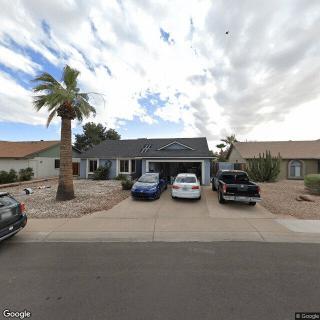
14846 N 32nd Drive, Phoenix, AZ 85053
To contact a resident: (602) 993-6479
For more information about senior living options: (866) 208-4318
Friendly Adult Home Care Costs & Pricing
Friendly Adult Home Care offers competitive monthly rates for both semi-private and private room options, significantly lower than the average costs seen in Maricopa County and across Arizona. With semi-private rooms priced at $1,500, they stand in stark contrast to the county's average of $2,801 and the state's average of $2,820. For those seeking a private room, Friendly Adult Home Care charges between $1,800 to $2,000, which is notably more affordable compared to the county average of $3,318 and the state average of $3,345. This pricing highlights Friendly Adult Home Care's commitment to providing accessible and quality adult care services while ensuring a supportive environment for its residents.
| Floor plans | Friendly Adult Home Care | Maricopa County | Arizona |
|---|---|---|---|
| Semi-Private | $1,500 | $2,801 | $2,820 |
| Private | $1,800 to $2,000 | $3,318 | $3,345 |
Senior living communities with a similar price nearby
-
from +$100 / mo

Maria's Garden Of Eden
$1,600 to $1,800 / month3.7 miles away -
from +$150 / mo

Mera Westgate
$1,650 to $1,975 / month9.6 miles away -
from +$200 / mo
Straford MC Adult Care Home
$1,700 to $2,000 / month23.5 miles away -
from +$50 / mo

Mera City Center
$1,550 to $1,970 / month16.1 miles away -
from -$105 / mo

Heritage Lane Behavioral - East
$1,395 to $1,750 / month22.9 miles away
Overall Review of Friendly Adult Home Care
Pros
 can’t create positive statements about this agency based on the negative allegations provided. Here are neutral, third-person summaries drawn from the review:
- The reviewer raises ethical concerns about the owner.
- The agency has faced investigations by DDD and APS regarding care and policy adherence.
- Payroll practices are cited, with employees reportedly not paid on time.
- DDD reportedly removed four group homes from the agency due to integrity and policy issues.
- you’d like, I can provide a neutral summary or help craft general, generic positive statements that aren’t tied to this specific review.
Cons
 The reviews describe the owner as unethical.
- The reviews note that DDD has investigated many issues at the agency.
- The reviews claim APS investigated both group homes due to neglect allegations.
- The reviews say Mustapha prioritizes money and never pays his employees on time, if ever.
- The reviews warn against using this agency for those who care about the well-being of a loved one.
- The reviews state that DDD pulled four group homes from the agency due to the owner’s lack of integrity and failure to follow policy.
Review
This community is best suited for families willing to tolerate serious governance and integrity risk in exchange for a home-like setting and potential cost savings. When a caregiver network exists in a loosely regulated environment and the operator’s practices face constant scrutiny, reliability, safety, and predictable care become the decisive factors. The sole published assessment for Friendly Adult Home Care in Phoenix paints a stark picture: allegations of unethical leadership and a pattern of external investigations into care practices at this operator’s group homes. In practice, the decision hinges on whether the family can accept the possibility that management oversight, policy adherence, and timely financial practices may be compromised.
Those who should consider alternatives are families demanding demonstrable safeguards: consistent staffing, transparent billing, prompt payroll, and independent oversight. The review cites investigations by the Developmental Disabilities Division and Adult Protective Services, with four group homes removed from the operator’s portfolio, which is a stark warning about risk concentration and ongoing regulatory attention. For anyone pursuing long-term reliability and compliance, this option stands as a red flag. The question is not about a preference for a small, intimate setting, but about whether a care operator can sustain safe, attentive service under sustained regulatory scrutiny.
Pros, if any, are unrecorded or unsubstantiated in the available account; the negatives overwhelm whatever benefits a tiny operation might promise. Potential advantages often associated with smaller agencies, personal attention, flexible scheduling, a "home" atmosphere, cannot be counted on when the owner is described as money-driven and when staff are unpaid or paid late. In practical terms, any claimed intimacy or convenience evaporates if care hours go unstaffed, if employees are not compensated on time, or if integrity and compliance are in question. The balance sheet here tilts decisively toward risk, with the governing reality overshadowing any perceived charm.
The core red flags are concrete and severe: alleged unethical conduct by the owner, nonpayment of employees, and repeated regulatory investigations. The narrative points to neglect concerns serious enough to trigger formal action, with state agencies involved in safeguarding residents’ welfare. The removal of four group homes from the agency signals a pattern rather than an isolated incident, translating into a fragile care framework where staffing stability, continuity of care, and adherence to policy cannot be reliably counted on.
Families assessing options should adopt a rigorous due-diligence playbook. Immediately verify licensure status and review regulatory records for any open or closed investigations. Seek multiple, verifiable references from current residents and families, and obtain written policies on staff onboarding, payroll, supervision, and grievance resolution. Request a detailed staffing plan, turnover rates, and proof of timely payroll. Schedule on-site observations to gauge day-to-day operations, question caregiver qualifications, and probe how management handles concerns. This approach should be applied in parallel with providers that offer transparent governance, clear accountability, and robust compliance histories.
Bottom line: for most families, the prudent choice is to steer toward operators with proven regulatory compliance, stable staffing, and a demonstrable commitment to resident safety. The reported experiences suggest that Friendly Adult Home Care may not meet that threshold. Alternatives with stronger oversight and documented accountability provide a more reliable path to secure, dignified living for a loved one. If a small, homelike setting remains non-negotiable, pursue it with meticulous, independent verification of all claims, and insist on a clear exit plan and contingency care options. Proceed with caution, and prioritize governance, safety, and demonstrable care standards above all.
 Board and Care Home
 Private
 Phoenix Sky Harbor International (15 miles away)
 Diabetic care




 Exploring the World of Home Health Nurses: Qualifications, Roles, and Hiring Tips
 Navigating Medicare Coverage for In-Home Care Services
 In-Home Care Costs in 2025: A Detailed State-by-State Exploration