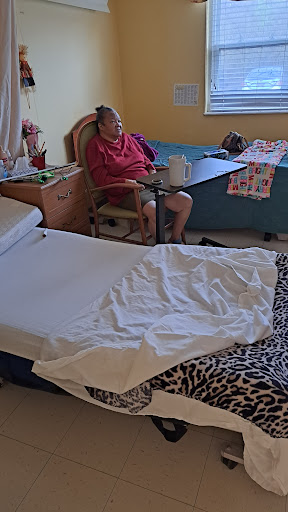

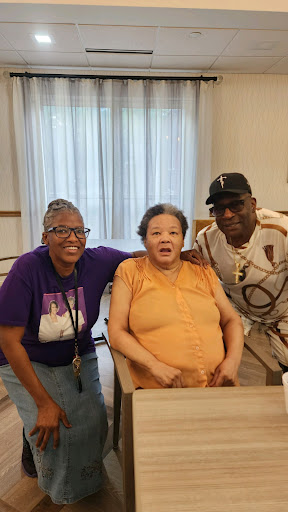
7220 Pippin Rd, Cincinnati, OH 45239
To contact a resident: (513) 729-2300
For more information about senior living options: (866) 208-4318
Overall Review of Lakeridge Villa
Pros
 The staff is always very helpful on the floors and in the office.
- The facility accommodates resident comfort by allowing a DVD player and a mini fridge in rooms.
- In Covid times, the staff and administrators have done an excellent job in keeping residents and families safe and well informed.
- Lakeridge is a good option when you are worried about caring for your loved ones.
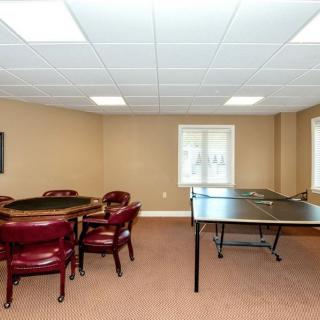
- Residents have access to a variety of activities and fun surprises.
- The nursing staff is friendly.
- There is a lake and a restaurant up the street, and the residents are taken there frequently.
- The staff seem to really care about the people living here.
Cons
 The reviewer would not take family members there if they required any kind of care.
- The facility does not administer medicine.
- The place is filthy, dirty, and disgusting.
- Management is pretty sad.
- Nurses have no clue what they're doing.
- The reviewer's wife had to be medically transferred 15 hours after arrival.
- The staff are rude and talk degrading toward residents.
- The air quality is terrible.
Review
Lakeridge Villa in Cincinnati is best suited for families seeking a budget-friendly, traditional assisted-living option where social engagement and personal comforts can be pursued, provided the resident’s needs are primarily light-to-moderate with limited demand for complex medical oversight. The community can deliver a familiar, homey atmosphere with accessible activities and a sense of local life, beyond that, prospective families should calibrate expectations toward ordinary maintenance and companionship rather than advanced clinical care. The setting tends to work when the emphasis is on companionship, routine supervision, and convenient access to local amenities rather than pristine facilities or highly responsive medical staffing.
Explicitly, those requiring reliable, professional medical management should consider alternatives. For residents who rely on meticulous medication administration, continuous clinical monitoring, or rigorous safety protocols, other options with stronger track records are advisable. Families evaluating care for serious health issues or advanced dementia will want facilities whose strengths lie in clinical acuity and consistent staffing. Similarly, if a modern, well-maintained building and quiet, respectful communication are nonnegotiables, it is prudent to widen the search to communities with more current infrastructure and stronger oversight.
On the positive side, staff presence and friendliness surface as meaningful strengths. Floor staff and office personnel are noted as helpful, and when care moments align, residents can enjoy reasonable comfort, evidence that the human touch can still shine in the right moments. Residents may have room-level conveniences like a DVD player and mini-fridge, signaling a willingness to accommodate simple comforts. The schedule of activities and local outings provides ongoing opportunities for engagement, and the proximity to a lake and nearby restaurant adds a recreational dimension that can support mood and social interaction.
Yet these strengths struggle to offset the core weaknesses that recur in multiple accounts. The most persistent concerns center on cleanliness, outdated furnishings, and perceived neglect in maintenance and upkeep. Reviewers describe the environment as old, poorly maintained, and with air quality and noise issues that undermine dignity and comfort. Management is repeatedly portrayed as unresponsive or ineffective at addressing problems, and there are explicit claims of rude or demeaning communication from staff toward residents. When basic safety and respect feel inconsistent, the day-to-day experience cannot reliably support a sense of security.
Another significant friction point is space and privacy, shared rooms, insufficient closet and storage space, and a lack of reliable personal storage for belongings. One family reports a long-standing clothing storage problem that leaves personal items disorganized and residents’ clothing displaced, turning daily visits into reminders of administrative shortfalls. These logistical and logistical-feel problems compound the sense that this is not a facility designed around resident dignity or smooth operation, even as some staff members clearly care and attempt to create positive moments with activities and outings.
The verdict for families weighing this option comes into sharp focus: Lakeridge Villa may be workable for those who prioritize affordability and social programming and can tolerate variability in care quality and facility standards. For families with higher expectations, cleanliness, timely and competent medical oversight, respectful resident-to-staff interactions, and consistently well-maintained living spaces, alternatives deserve serious consideration. Prospective buyers should pursue targeted inquiries: request recent inspection or survey results, tour at different times, verify room assignments and storage solutions, and speak directly with leadership about problem-resolution procedures. The community’s warmth in some shifts does not erase the reality that, overall, the balance leans toward caution and a careful comparison with stronger-performing options.
 Skilled Nursing Facility
 Cincinnati Northern Kentucky International (12 miles away)
 Exploring Nonmedical Home Care: Understanding Services, Costs, and Financial Approaches
 Engaging Brain Games and Innovative Apps to Keep Senior Minds Active
 Effective Strategies for Keeping Seniors' Minds Active: A Deep Dive into Brain Games and Apps