
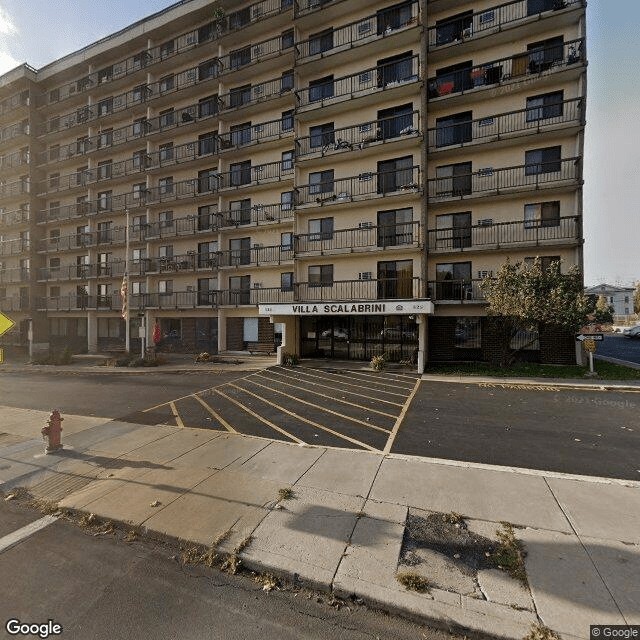
825 E Willow St, Syracuse, NY 13203
To contact a resident: (315) 472-3142
For more information about senior living options: (866) 208-4318
Overall Review of Villa Scalabrini
Pros
 The proximity to a park and public transit is a valued feature.
- A fairly large shopping area is conveniently located just a few blocks away.
- The building provides weekly shopping buses to Wegmans and Tops, and twice a month to Walmart, which adds convenience.
- The overall location and amenities offer convenient access to shopping and transit.
Cons
 The management is poor.
- The listing claims to be smoke-free, but that claim is not true.
- The onsite manager treats residents unfairly.
- Non-smokers and non-drug users are discouraged from moving in, with residents reporting secondhand smoke complications.
Review
Villa Scalabrini in Syracuse is best suited for residents who are comfortable with a smokier environment and who need straightforward access to everyday conveniences. The community tends to attract older adults who either smoke or tolerate secondhand exposure, and who value proximity to a park, public transit, and nearby shopping. The building runs weekly shopping buses to Wegmans and Tops and twice monthly trips to Walmart, a practical lifeline for those who prefer not to drive. In essence, this is a place that serves a specific niche: people who do not require a strictly smoke-free milieu and who can navigate less consistent management.
Those who should consider alternatives include non-smokers and families seeking a consistently smoke-free environment. Reliability of management is a pivotal issue here; multiple residents describe unfair treatment by the onsite manager and broader governance gaps that undermine daily living. For health-sensitive residents, especially those with respiratory concerns or loved ones who visit often, this is a red flag that outweighs location-based benefits. Potential residents who rely on predictable rules and prompt issue resolution will likely be better off exploring other communities with stronger enforcement and a more resident-centric culture.
On the upside, the location offers tangible conveniences: proximity to a park and easy access to transit, plus a dense shopping area within blocks. The shuttle service to major grocery stores is a meaningful feature that reduces dependency on driving and supports independence. Yet these positives are systematically challenged by the dominant concern: the environment often feels smoky, and promises of a smoke-free setting do not consistently translate into daily experience. The resulting tension between convenience and health risk shapes a cost-benefit picture that rarely tips in favor of staying, once health considerations are weighed.
Health and safety implications of ongoing smoke exposure are pointedly mentioned by residents. Secondhand smoke complications are described as a direct consequence of the policy gap, which frames daily life with irritants or respiratory discomfort. Coupled with unfair treatment claims against the onsite manager, the resident experience becomes unstable and unpredictable. When policy intent appears inconsistent with practical reality, trust erodes, and decisions hinge on whether the family can tolerate air quality variation, potential policy reversals, and the risk of selective rule enforcement. These dynamics are crucial in deciding whether this community aligns with long-term care goals.
To make an informed decision, focus on eight practical checks during a visit: is there a verifiable, enforced smoke-free policy with clear air-quality expectations? what is the actual pattern of smoking allowed indoors or within common areas? how transparent is the grievance process, and how quickly does management respond to concerns? what evidence exists of manager accountability and fair treatment across residents? how consistent are the shuttle schedules and transportation options? are there documented procedures for visiting guests or for maintenance and safety concerns? these questions illuminate whether the comfort of location comes with a cost that can be absorbed without compromising health or dignity.
In sum, Villa Scalabrini serves a niche, smokers or those tolerant of smoke exposure who prize location and transit convenience over governance consistency. For non-smokers and families who require a reliably smoke-free environment and a collaborative, responsive management culture, alternatives should be prioritized. If the choice is to explore this community, enter with a focused due-diligence plan, demanding concrete answers on enforcement and staffing, and a clear understanding that health considerations and fairness may trump proximity in the final decision.
 Independent Living
 Syracuse-Hancock International (4 miles away)





 Understanding the Nuances of Palliative Care and Hospice: A Comprehensive Exploration
 Fecal Incontinence in Older Adults: A Comprehensive Guide
 Nurturing Well-Being Through Gardening: A Detailed Guide for Senior Enthusiasts