
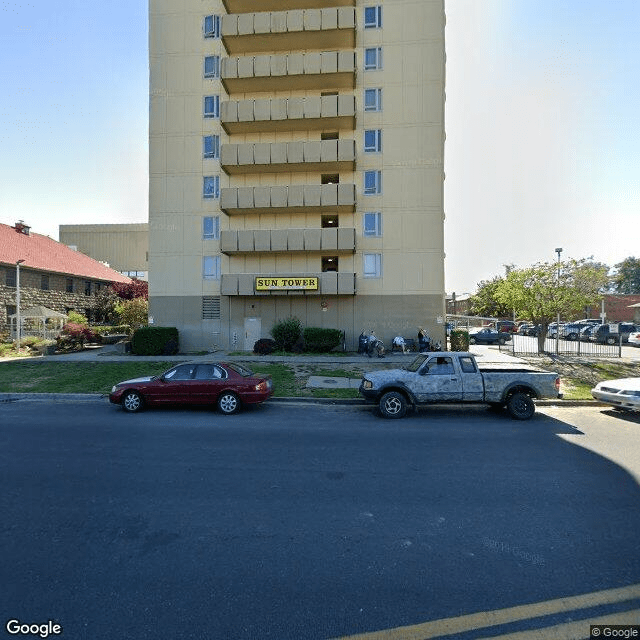
6 North 6th Street, Yakima, WA 98901
For more information about senior living options: (866) 208-4318
Sun Tower Costs & Pricing
Sun Tower stands out as a cost-effective option compared to the broader market rates in Yakima County and Washington state. For instance, the monthly cost of a studio apartment at Sun Tower is $708, significantly lower than the county average of $3,231 and even more so compared to the state average of $4,126. Similarly, the one-bedroom unit at Sun Tower is priced at $758, contrasting sharply with Yakima County's rate of $3,572 and Washington's statewide figure of $4,632. Even when considering private accommodations, which are typically more expensive across the board, Sun Tower offers a competitive rate of $4,021 against Yakima County's $4,679 and Washington's average of $4,772. These figures clearly illustrate that Sun Tower provides not only affordability but also value for residents seeking comfortable living arrangements within the area.
| Floor plans | Sun Tower | Yakima County | Washington |
|---|---|---|---|
| Studio | $708 | $3,231 | $4,128 |
| 1 Bedroom | $758 | $3,572 | $4,634 |
| Private | $4,021 | $4,679 | $4,774 |
Overall Review of Sun Tower
Pros
 They describe some residents as awesome people.
- Some assisted living caretakers are great at their jobs.
- Most caretakers follow instructions.
Cons
 The maintenance supervisor and the director are described as lacking confidence.
 - It’s stated that this is not an assisted living facility but an independent living facility, with owners who have stripped basically all value from the building.
- There is no activity director because hours were cut to less than eight per week, and she quit and left.
- The maintenance crew is only three people, with the janitor working about 30 hours a week and the security guard overlapping in that same limited schedule.
- Several residents have wandered around naked while their spouses slept.
- The main activities are said to be gossip and drinking.
- The facility is described as very unclean.
- The administrator is said to smoke more than she works; there is no housekeeping; security is poor; access to a key fob and storage unit is selectively granted.
- A 22-year-old maintenance supervisor is claimed to be unable to replace a toilet.
- Fire alarms reportedly go off regularly.
- Residents report no heat, no fan, or no air, and attempts to contact the corporation have been made, with mentions of going to news or HUD for attention.
- Subsidized housing with sparse activities and staff who do the bare minimum.
- The complex is described as 57 years old, near downtown, with many homeless wandering by; elevators are out 2-5 days a month; repairs take 1-4 weeks; two floors have no cable; smoking in apartments is common despite rules.
Review
Sun Tower in Yakima is best suited for independent seniors who are seeking the lowest-ask, subsidized housing option and can absorb a sparse level of on-site services. The building functions as a basic, older complex rather than a full-service assisted living environment. Residents who can self-manage daily needs, tolerate limited programming, and endure an aging-in-place setting may find the arrangement affordable and workable. However, this is not a place designed for meaningful daily care, vigilant supervision, or robust activity schedules. Prospective residents should expect minimal housekeeping, inconsistent on-site staffing, and a building that relies on self-sufficiency rather than a care plan.
That reality makes it important for certain residents to consider alternatives. Families evaluating Sun Tower should be wary if a loved one requires regular assistance, strong safety nets, or consistent, structured activities. Those seeking reliable housekeeping, dependable security, or prompt, quality maintenance will likely find better options elsewhere. Even in independent living, many will prefer a facility with a dedicated activity coordinator, clearer accountability, and a more proactive management approach. For anyone aiming for a higher standard of cleanliness, safer surroundings, and more predictable service levels, exploring other communities is prudent.
The main pros, affordability and independence, do not substantially offset the gravest drawbacks. The cost appeal matters, but it is counterbalanced by a building whose maintenance and administration appear under-resourced. Some residents may encounter a sense of routine social friction, while others will endure periods of disorganization, delayed repairs, and unreliable amenities. The limited activity offerings and sparse staff presence translate into a quieter, more fragmented social scene, which could suit a highly self-directed resident but will frustrate families seeking a certain vibrancy and support network. In this balance, price cannot compensate for ongoing safety and cleanliness concerns.
Safety and upkeep dominate the risk profile here. Several accounts describe maintenance crews that feel underqualified for typical tasks, with elevators that are frequently out and repairs taking weeks. Heating or cooling issues surface, and fire alarms are reported to sound regularly. The building’s physical state appears aging, with carpets that may not meet expectations of cleanliness and common areas that lack consistent attention. Add in a neighboring environment with wandering individuals and occasional smoking inside apartments, and the risk calculus shifts toward environments that offer stronger security, clearer policies, and more proactive maintenance. These factors collectively erode quality of life and peace of mind for both residents and families.
From a decision-making standpoint, families should verify concrete details before moving forward. Inquire about current staffing levels, who manages maintenance requests, and how quickly issues are resolved. Confirm whether the property offers any on-site activities or life enrichment programs and whether an activity director is employed with reliable hours. Scrutinize housekeeping arrangements and whether routine cleaning is included or optional for residents. Examine safety procedures, access controls, and the consistency of heat, air, and cable services. Most importantly, observe current residents’ interactions with staff and management to gauge responsiveness and accountability.
Ultimately, Sun Tower is not a strong fit for anyone who needs daily care, advanced medical support, or dependable, robust programming. It may work for a highly independent senior who can tolerate a hands-off service model and who prioritizes affordability above all else. For those requiring assistance, predictable structure, or a consistently clean and safe environment, alternatives should be pursued. A well-informed decision will emerge from firsthand tours, candid discussions with current residents, and a clear understanding of what daily life will look like under the current management and maintenance regime.
 19 resident community capacity
 Active Adult Communities (55+)
 Assisted Living
 Board and Care Home
 Independent Living
 Cats allowed
 Dogs allowed
 Activities on-site
 Air-conditioning
 Bath tubs
 Beautician on-site
 Cable or satellite TV
 Devotional services on-site
 Dining room
 Full kitchen
 Fully furnished
 Garden
 Handicap accessible
 Housekeeping services
 Indoor common areas
 Move-in coordination
 Outdoor common areas
 Telephone
 Wheelchair accessible showers
 Wi-Fi/high-speed internet available
 24-hour supervision
 Ambulatory care
 Assistance with bathing
 Assistance with dressing
 Assistance with transfers
 Diabetes diet
 Diabetic care
 Meal preparation and service
 Medication management
 Special dietary restrictions
 Transportation arrangement (medical)
 Transportation to doctors appointments
 Bible study group
 Bridge club
 Live dance or theater performances
 Live musical performances
 Resident band or musicians
 Social Security Benefits and Assisted Living: Navigating Options Across the U.S.
 An Extensive Exploration of the VA Aid and Attendance Benefit
 Senior Transition Services: Understanding Their Role, Cost, and Importance