Residents and families consistently describe staff as welcoming and attentive.
Many reviews highlight staff who are welcoming, helpful, and easy to communicate with. Several residents or family members say staff treat them with respect and compassion, including in nursing and assisted living settings. A smaller set of reviews express serious concern about care quality, staffing, and how residents are treated.
common9 reviews mention this
Cleanliness and upkeep get praise
Clean, well-maintained spaces are a frequent positive in reviews.
Multiple reviews describe the facility as clean, updated, and well organized, with spotless common areas and bathrooms. Others mention the grounds and facilities being very well maintained. Even one mixed review that discussed other issues still notes the absence of foul odors in the skilled setting.
common6 reviews mention this
Food is repeatedly mentioned
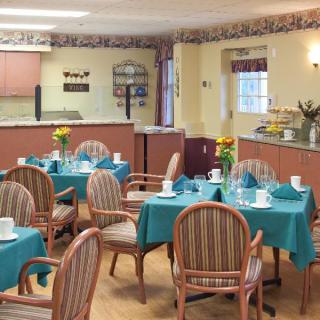
Dining quality shows up often in residents’ and families’ comments.
Several reviews praise the food as very good or excellent, and some mention specific items like pizza. Families also describe enjoying meals together in the dining room. At least one resident review includes feedback that aligns with strong dining satisfaction, even when other parts of the experience are more mixed.
common7 reviews mention this
Activities and engagement feel active
Reviews describe regular activities that help residents stay involved.
Many residents and families mention events, shows, and music-based activities, along with residents joining in rather than staying isolated. Several reviews describe a community atmosphere built around ongoing engagement and social opportunities. One review contrasts that by saying there were no activities, which is an outlier compared with the rest of the comments.
caveat5 reviews mention this
Care concerns include staffing and medication
Some reviews raise serious concerns about care practices and staffing.
A few reviews describe problems such as concerns about medication practices in memory care and the availability of nursing coverage at night. Others report negligent care, nursing or communication errors, and issues that led to harm or frustration. While many other reviews are highly positive about care, these critical accounts are prominent enough to treat as a major caveat.
common2 reviews mention this
Close to shopping and healthcare
Families mention being close enough for regular outings.
Some reviews say the area makes it easier to reach shopping, healthcare, and restaurants without a long trip. In the nearby area, there are options for quick stops like pharmacy locations and clinics. The convenience theme shows up alongside comments that residents still have access to community life beyond the campus.
How we summarize
Counts show how many written reviews mention each theme; a review can touch several themes, and only frequently mentioned themes are displayed.
Features
Types of Care
Assisted Living
Independent Living
Memory Care
Amenities
Activities on-site
Devotional services off-site
Indoor common areas
Transportation
Lehigh Valley International (24 miles away)
Care Services
Ambulatory care
Diabetic care
Dining
Meals provided
Activities
Activities on-site
Devotional activities offsite
Nearby Places of Interest
Pharmacies
CVS Pharmacy (2.8 miles)
CVS Pharmacy (3.5 miles)
CVS Pharmacy (5.8 miles)
Professional Pharmacy of Pennsburg/Red Hill (6 miles)
Landis Supermarket (6.3 miles)
CVS Pharmacy (6.4 miles)
Walgreens (6.5 miles)
Physicians
Complete Family Eyecare (3.1 miles)
Performance Spine and Sports Physicians, PC (5.9 miles)
Choosing between assisted living and nursing homes involves evaluating emotional and financial factors, with assisted living offering independence and support for daily activities at a lower cost, while nursing homes provide intensive medical care for individuals with significant health needs. The decision is influenced by personal preferences, health status, cognitive function, and varying Medicaid coverage across states.
The article presents eight strategies for preserving cognitive health and memory in older adults, emphasizing a nutrient-rich diet, regular exercise, intellectually stimulating activities, adequate sleep, social connections, stress management techniques, limiting harmful substances, and regular medical checkups to mitigate age-related memory decline.
Activities of Daily Living (ADLs) are fundamental tasks vital for an individual's independence, particularly in older adults over 85, and include functions like bathing and dressing; assessing ADLs alongside Instrumental Activities of Daily Living (IADLs) helps determine the level of required assistance due to age-related health challenges. Tailored support plans, involving family and community resources, are essential for maintaining dignity and autonomy in assisted living environments.
Get PricingAsk A QuestionSchedule A TourContact Senior Advisor
By clicking submit, you agree to our Partner's Terms of Use. You
also consent to receive calls and texts, which may be autodialed, from our Partner. Your consent is not a condition to
using our Partner's service. Please visit our Partner's Privacy Policy for information about their privacy practices.

 Assisted Living
 Independent Living
 Memory Care
 Activities on-site
 Devotional services off-site
 Indoor common areas
 Lehigh Valley International (24 miles away)
 Ambulatory care
 Diabetic care
 Meals provided
 CCRC with full continuum of care and on-site amenities (dining, activities, transportation).
 Choosing the Right Senior Care: A Detailed Exploration of Assisted Living and Nursing Homes
 Safeguarding Your Memory Through the Golden Years: Eight Ways to Preserve Cognitive Health
 Comprehensive Insights into Activities of Daily Living (ADLs) and Their Assessment