
632 North 21st Street, Coeur D'alene, ID 83814
For more information about senior living options: (866) 208-4318
Rose Terrace Cottages Costs & Pricing
Rose Terrace Cottages offers competitive pricing for its accommodation options, particularly when compared to both Kootenai County and the broader state of Idaho. For semi-private rooms, residents can expect a monthly cost of $2,500, which is significantly more affordable than the county average of $3,304 and the state average of $3,026. Similarly, for studio units priced at $2,900, Rose Terrace remains well below the county's benchmark of $3,512 and Idaho's average of $3,213. These attractive rates underscore Rose Terrace Cottages' commitment to providing quality living arrangements that are accessible and budget-friendly for potential residents and their families.
| Floor plans | Rose Terrace Cottages | Kootenai County | Idaho |
|---|---|---|---|
| Semi-Private | $2,500 | $3,304 | $3,026 |
| Studio | $2,900 | $3,512 | $3,213 |
Assisted Living communities with a similar price nearby
-
About the same

North Star
$2,484 to $4,482 / month2.9 miles away -
from +$195 / mo
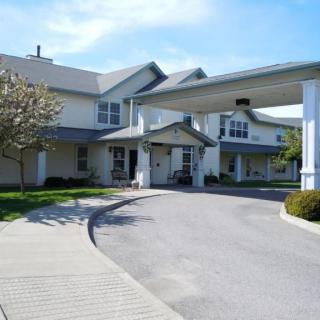
Sullivan Park Assisted Living Community
$2,695 to $4,450 / month21.0 miles away -
from +$300 / mo
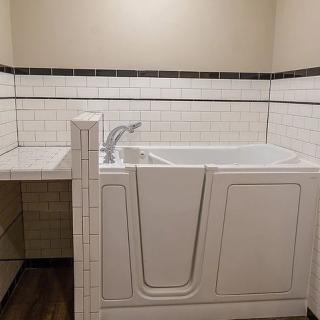
Peterson Place
$2,800 to $3,500 / month5.2 miles away -
from -$305 / mo
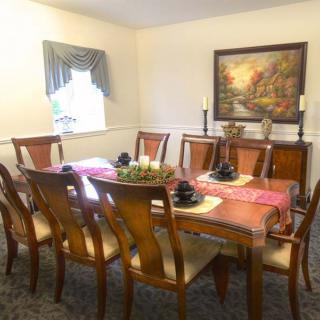
Evergreen Fountains Senior Living Community
$2,195 to $2,950 / month21.6 miles away -
from -$100 / mo
Hearthstone Village
$2,400 to $2,800 / month9.2 miles away
Overall Review of Rose Terrace Cottages
Pros
 Rose Terrace Cottages feels like a home filled with family that cares for one another.
- The staff go the extra mile to ensure residents receive the best care.
- The residents are treated like family, not just numbers.
- The small house setup allows for individualized attention to each resident.
- The facility is very clean and offers a welcoming three-house configuration.
- Each house is well staffed, with dining, kitchen, living room, and laundry spaces.
- The environment has a home vibe, with staff who get along like a family and treat residents with respect and sensitivity.
- The care focuses on residents’ physical, mental, and emotional health every day.
- The Rose Terrace Cottage team is incredible, kind, and patient.
- Elaine Magnus is fantastic and fully committed to those in her care.
Cons
 The facility is described as a mess and unorganized, with staff not trained at all and the owner called an absolute nightmare.
 - It is claimed that a parent was put in a room and left there without proper care, effectively waiting to die.
- The reviewers allege a lack of nutrition and overall neglect, with staff not assisting residents.
- Extremely poor communication is reported among everyone who works there, with calls going unanswered.
- Items such as glasses and socks were lost, teeth were not brushed, and blame was placed on the resident for these issues.
- Scheduling is mishandled and some staff are described as rude, with inadequate pay checks.
- At least one reviewer would give 0 stars and warns not to send loved ones there.
- A strong warning is issued: do not put your parent here.
Review
Rose Terrace Cottages in Coeur d’Alene is best suited for families seeking a truly home-like, intimate assisted living experience where residents are treated like family and care is personalized in a small, house-by-house format. This community excels when the senior thrives on routine, meaningful social connection, and direct access to caregivers who know them by name. The three-house setup, each with its own dining and living spaces, creates a warm, neighborhood feel that supports daily living assistance without the impersonal feel of a larger campus. For residents who value meals shared around a table, casual gatherings, and staff who can respond promptly to evolving needs, Rose Terrace delivers a sense of belonging that others often struggle to achieve.
That said, prospective families should explicitly consider alternatives if strict, institution-grade oversight is non-negotiable. The most serious cautions come from concerns about organization, communication, and consistent staffing, issues that appear in some reviews and raise questions about long-term reliability. For residents requiring complex medical management, highly structured memory care, or a facility with a larger, more formalized administrative framework, Rose Terrace may not meet every standard. Families should weigh whether they can tolerate potential scheduling gaps, inconsistent messaging, or perceived gaps in oversight, and they should compare with facilities that emphasize rigorous processes and standardized care protocols.
The strongest positives, the evident warmth of staff, the sense that residents are cared for beyond basic needs, and the ability to deliver one-on-one attention, help offset the main drawbacks. Multiple accounts paint Rose Terrace as a place where caregivers go “the extra mile,” where residents feel seen, and where meals are part of a family-like daily rhythm. The small-scale environment minimizes the odds of residents becoming anonymous or slipping between cracks, and 24/7 presence in some staff narratives suggests a level of accessibility that larger centers may not consistently offer. When care teams are cohesive and residents are treated with respect, the risk of neglect or neglectful routines can feel smaller even if administrative hiccups persist.
Yet the weight of the cons cannot be dismissed. Reports of disorganization, inadequate staff training, and poor communication loom as real risk factors that can affect medication management, scheduling, and basic daily needs. Occasional anecdotes about lost items, missed care tasks, or delayed responses highlight the potential for lapses in a setting that relies heavily on consistent, hands-on oversight. The counterbalance is that many residents and families do report strong, compassionate leadership from the caregiving team, and some administrators are described as truly responsive. The prudent approach is to verify, in person, how the daily operations are actually run and who is supervising care on each shift.
Practical steps will determine fit more clearly than accolades or warnings alone. Arrange a full tour and ask to speak with current residents and several families about their day-to-day experiences. Inquire about staff-to-resident ratios, shift coverage, training, and how care plans are developed and updated. Request to review recent licensing, incident logs, and any state compliance records, and ask to meet the administrator who would be the point person for concerns. Explore how meals, activities, medication administration, and transportation are handled, and whether there is a clear process for emergencies. Finally, consider a trial period or a phased transition to assess real-world functioning in the home atmosphere Rose Terrace creates.
In sum, Rose Terrace Cottages represents a compelling option for seniors who prize a heartfelt, home-centered living experience and who can tolerate the possibility of occasional administrative gaps. Its core strengths, the closeness of staff, genuine care, and a family-like environment, can deliver outstanding quality of life when the care is well-coordinated. For families prioritizing rigorous, institution-like governance or those with higher medical complexity, exploring alternatives with stronger formal oversight may be wise. The right choice hinges on aligning the senior’s daily needs and risk tolerance with the facility’s ability to deliver reliable, compassionate care in a small, intimate setting.
 15 resident community capacity
 Assisted Living
 Board and Care Home
 Activities on-site
 Cable or satellite TV
 Devotional services off-site
 Dining room
 Fully furnished
 Garden
 Housekeeping services
 Indoor common areas
 Move-in coordination
 Outdoor space
 Telephone
 Wi-Fi/high-speed internet available
 24-hour supervision
 Ambulatory care
 Assistance with bathing
 Assistance with dressing
 Assistance with transfers
 Diabetes diet
 Diabetic care
 Meal preparation and service
 Medication management
 Special dietary restrictions
 Transportation arrangement (medical)
 Transportation to doctors appointments




 When to Transition from Assisted Living to Memory Care: Key Indicators, Steps, and Finding the Right Community
 Assisted Living and Memory Care: Understanding Their Core Differences
 Beyond the Bingo Hall: 50+ Enriching Activities for Seniors in Assisted Living