
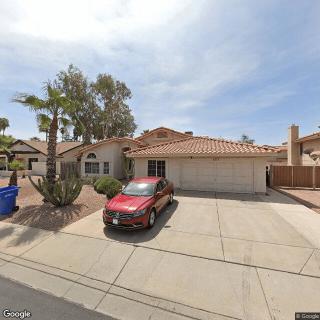
9635 West Cielo Grande, Peoria, AZ 85383
For more information about senior living options: (866) 208-4318
At Parkridge Assisted Living II Costs & Pricing
At Parkridge Assisted Living II, the monthly cost for a private room is $4,000, which reflects a premium compared to the average prices in Maricopa County and the broader state of Arizona. In contrast, the average monthly costs in Maricopa County are approximately $3,318, while statewide averages hover around $3,345. This suggests that At Parkridge offers a more elevated level of service or unique amenities that may justify its higher price point. Residents and their families may consider this investment worthwhile for the enhanced quality of care and living environment provided by this facility.
| Floor plans | At Parkridge Assisted Living II | Maricopa County | Arizona |
|---|---|---|---|
| Private | $4,000 | $3,318 | $3,345 |
Assisted Living communities with a similar price nearby
-
from -$160 / mo

Elite Senior Living
$3,840 to $4,992 / month9.6 miles away -
from -$500 / mo

The Greenway Manor II
$3,500 to $4,000 / month18.8 miles away -
from -$500 / mo
Diamond Quality Assisted Living Care Home
$3,500 to $4,500 / month19.2 miles away -
About the same
Desert Joy Assisted Living
$4,000 / month1.1 miles away -
About the same
Quail Manor Assisted Living
$4,000 to $4,900 / month7.3 miles away
Overall Review of At Parkridge Assisted Living II
Pros
 Milton receives the utmost care from Jeron and Marvin.
- Jeron and Marvin are amazing caregivers.
- Marvin was amazing to the family and to Dale.
- Marvin made Dale feel at home and kept the family informed of changes.
- Marvin made Dale's last months very comfortable and pleasant.
Review
Parkridge Assisted Living II in Peoria is best suited for families that prize intimate, hands-on caregiving where caregivers become familiar, trusted partners in daily life. The two reviews describe a small, approachable environment where staff attention feels highly personal, and where residents appear to be treated with warmth and respect. This community works best for seniors who do not require constant high-acuity medical intervention but who want reliable daytime presence, clear communication with families, and a home-like routine that supports dignity and comfort.
Those considering alternatives should note that the current impression rests on a very small sample, two reviews, and centers on a limited number of caregivers. Families seeking more extensive clinical oversight, around-the-clock nursing, or a larger, more standardized care team may want to explore options with bigger staff rosters and more formalized medical programs. For residents who require specialized memory care, chronic disease management, or highly structured activity schedules, other facilities with dedicated memory care wings or on-site licensed nurses may prove a better fit.
The strongest and most consistent positives are caregiver quality and family communication. The reviewers repeatedly highlight Marvin and Jeron as standout providers who made their loved ones feel at home, stayed attentive to changes, and kept relatives well informed. This level of personal connection matters immensely in assisted living, translating into tangible benefits for the resident’s sense of security, daily comfort, and overall well-being during difficult times. When staff members cultivate trust and continuity, families experience less anxiety about daily routines and care decisions, which is a meaningful offset to the inherent uncertainties of aging at home.
These advantages offset many potential concerns by creating a lived experience that centers comfort, familiarity, and transparent dialogue. The impression of a small, caregiver-driven environment often means fewer bureaucratic hurdles, quicker problem-solving, and a sense that staff truly sees the resident as a person rather than a chart. In contexts where a resident’s stay is emotionally challenging, such as the last months of life, this kind of relational care can be decisive, making the day-to-day more predictable, calmer, and more meaningful for both resident and family.
However, the favorable view rests on limited data. With only two reviews, the reliability of the narrative depends on the consistency of a small team across shifts and over time. Potential families should probe for staffing patterns, shift coverage, and whether Marvin and Jeron represent the full spectrum of caregivers or if a broader team delivers most day-to-day care. In addition, there is little information about the facility’s medical oversight, nutrition, activities, transportation, or emergency protocols beyond the caring demeanor described. These gaps suggest the need for an on-site visit and a careful review of care plans, schedules, and staff qualifications before making a commitment.
In the end, Parkridge II presents a compelling option for families who value warmth, direct caregiver relationships, and transparent family communication. It is a practical choice for those who want a homelike setting where a couple of standout caregivers can make a real difference in a resident’s comfort and state of mind. For families prioritizing medical acuity management, comprehensive activity programming, or a broad, consistent staff, it makes sense to compare with other communities that emphasize larger teams and formal clinical support. Prospective residents should arrange a thorough tour, meet the primary caregivers, request a sample care plan, and ask pointed questions about staffing coverage, medical support, and daily programming to ensure alignment with evolving needs.
 5 resident community capacity
 Assisted Living
 Board and Care Home
 Respite Care
 Cable or satellite TV
 Dining room
 Fully furnished
 Garden
 Housekeeping services
 Move-in coordination
 Outdoor space
 Telephone
 Wi-Fi/high-speed internet available
 Phoenix Sky Harbor International (24 miles away)
 24-hour supervision
 Activities of daily living assistance
 Assistance with bathing
 Assistance with dressing
 Assistance with transfers
 Diabetes diet
 Meal preparation and service
 Medication management
 Special dietary restrictions
 Transportation arrangement (medical)
 Transportation to doctors appointments






 Comprehensive Supportive Living Arrangements for Adults with Disabilities
 Funding and Affording Assisted Living: A Thorough Overview
 Assisted Living Expenses and Long-Term Care Insurance: A Comprehensive Exploration