
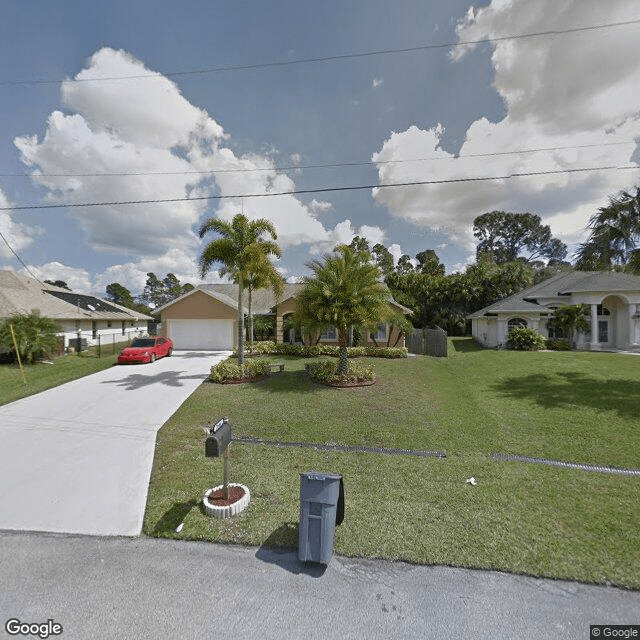
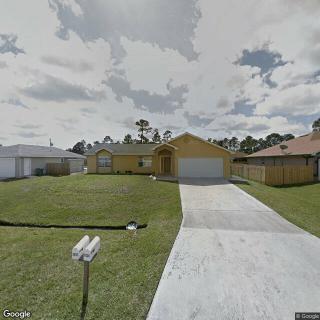
2666 Southwest Ace Road, Port Saint Lucie, FL 34953
To contact a resident: (772) 985-8841
For more information about senior living options: (866) 208-4318
The Perfect Place 2 Costs & Pricing
The Perfect Place 2 offers competitive pricing that stands out favorably against both St. Lucie County and the broader state of Florida. For semi-private accommodations, residents can expect to pay $2,500 per month, which is significantly lower than the county average of $2,717 and the state average of $3,009. When it comes to private rooms, The Perfect Place 2's monthly rate of $4,000 is slightly higher than St. Lucie County's average of $3,665 but remains closely aligned with the state's average of $3,699. Additionally, for those seeking studio apartments, The Perfect Place 2's rate of $5,000 exceeds both local and state averages - $3,880 and $3,823 respectively - highlighting a premium offering that may cater to a more upscale market segment. Overall, The Perfect Place 2 positions itself as an attractive option particularly for semi-private living while maintaining competitive pricing for private spaces.
| Floor plans | The Perfect Place 2 | St. Lucie County | Florida |
|---|---|---|---|
| Semi-Private | $2,500 | $2,717 | $3,009 |
| Private | $4,000 | $3,665 | $3,699 |
| Studio | $5,000 | $3,880 | $3,823 |
Memory care communities with a similar price nearby
-
About the same

Caring Hands of the Treasure Coast
$2,500 to $3,000 / month2.9 miles away -
from -$200 / mo
Nelisha Family Home
$2,300 to $4,500 / month2.4 miles away -
from +$400 / mo

Broadmoor ALF
$2,900 to $3,200 / month10.0 miles away -
About the same

Wickshire Port St. Lucie
$2,500 to $4,295 / month5.2 miles away -
from +$300 / mo

Grace Manor
$2,800 to $3,200 / month3.9 miles away
Overall Review of The Perfect Place 2
Pros
 The staff were somewhat helpful.
Cons
 They did not like the community.
- They would not recommend this community.
- They would not assist with a refund.
Review
The Perfect Place 2 in Port Saint Lucie, FL, is best suited for families facing a very tight choice set who need a brief, low-expectation stopgap for a loved one and can tolerate limited staff engagement and uncertain refund outcomes. The recent feedback frames the community as a short-term, low-commitment option rather than a stable, supportive home for ongoing care. In practical terms, it may show up as a temporary placement during a crisis, but not as a reliable long-term solution for anyone requiring consistent supervision, medical oversight, or proactive resident advocacy.
Those with ongoing needs or clear expectations for transparency and dependable service should seriously consider alternatives. For families seeking meaningful, stable assisted living or memory care, the absence of a track record of reliable care and a willingness to engage families in a constructive manner is a warning sign. Long-term care professionals would likely steer families toward facilities with stronger staffing, clearer policies, and proven continuity of care, or toward in-home options that offer steadier oversight and fewer policy-edge encounters.
Two small positives emerge in the reviews: staff presence appears to be at least somewhat helpful when engaged, a modicum of responsiveness that offers momentary reassurance. Yet this limited advantage does not offset the core concerns. The experience described by families centers on an environment that feels transient and insufficiently supportive, with little evidence of a structured program or dependable continuity of care. In practice, the pros are outweighed by the overarching impression of instability and incomplete service.
The dominant cons eclipse any potential upside. The clearest red flag is the account of a loved one placed for a single day before being removed, accompanied by a firm stance on refunds that offers no meaningful remedy or accommodation to families seeking recourse. That combination, very short stays followed by a reluctance to engage in clarifying or rectifying financial issues, casts a long shadow over the facility’s credibility as a stable caregiving option. When families own the decision about the next steps, the lack of a predictable, supportive response from administration becomes a decisive barrier.
For families evaluating options, a practical course is essential. Conduct thorough on-site inspections with a focus on daily care routines, nurse or caregiver availability, and how emergencies are managed. Bring written questions about refunds, move-out processes, and any cancellation penalties, and insist on a clear, legally binding policy. Request to speak with current residents and multiple former families about their experiences, not just the official line. Ensure a transparent contract that spell out services included, what constitutes a breach, and how disputes are resolved. In short, perform due diligence that tests not only the vibe during a tour but the facility’s actual responsiveness when concerns arise.
Ultimately, this community does not seem aligned with the needs of families seeking reliable, long-term assisted living or memory care. The combination of a brief, unsatisfying stay pattern and a nonresponsive approach to refunds signals a high probability of disappointment for most residents who require ongoing care, consistent staffing, and predictable financial terms. If a calm, continuous caregiving environment is the goal, alternatives with documented care protocols, stronger staffing commitments, and transparent financial policies should be prioritized. In situations where options are truly limited, proceed with aggressive inquiry and clear expectations, but prepare to move to a higher-quality setting as soon as feasible.
 Board and Care Home
 Day Program
 Memory Care
 Bath tubs
 Beautician on-site
 Devotional services off-site
 Indoor common areas
 Outdoor common areas
 Private
 Private bathrooms
 Respite or short term stays offered
 Swimming pool / hot tub
 Wheelchair accessible showers
 Diabetic care
 Incontinence care
 Kosher




 Memory Care Pathways: A Holistic Guide to Dementia Support
 Comprehending Evening Confusion in Dementia: Causes, Manifestations, and Support
 Delirium and Dementia: Unraveling the Key Differences