
1 Ferris Hills, Canandaigua, NY 14424
To contact a resident: (585) 393-0410
For more information about senior living options: (866) 208-4318
Ferris Hills at West Lake Costs & Pricing
Ferris Hills at West Lake offers competitive monthly costs for its accommodations when compared to the broader market in Ontario County and the state of New York. For a one-bedroom unit, residents can expect to pay $2,765, which is considerably lower than both the county average of $3,320 and the state average of $4,307. Similarly, in the case of two-bedroom units, Ferris Hills' rate of $3,025 is slightly above the local county figure of $2,997 but remains significantly more affordable than New York's state average of $4,786. These pricing dynamics highlight Ferris Hills at West Lake as an appealing option for those seeking quality living arrangements without breaking the bank.
| Floor plans | Ferris Hills at West Lake | Ontario County | New York |
|---|---|---|---|
| 1 Bedroom | $2,765 | $3,320 | $4,307 |
| 2 Bedrooms | $3,025 | $2,997 | $4,786 |
Independent Living communities with a similar price nearby
-
About the same
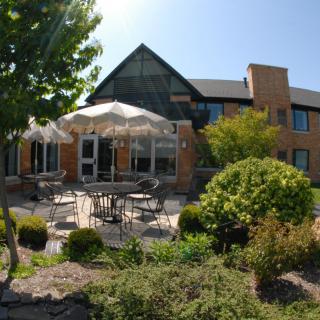
The Summit at Brighton a CCRC
$2,724 to $3,554 / month22.4 miles away -
from -$415 / mo
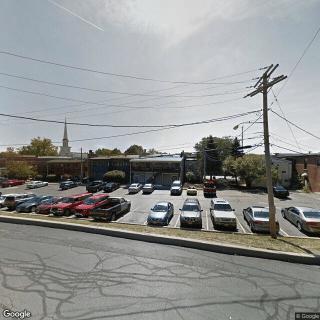
Forest Park
$2,350 to $2,900 / month10.2 miles away -
About the same
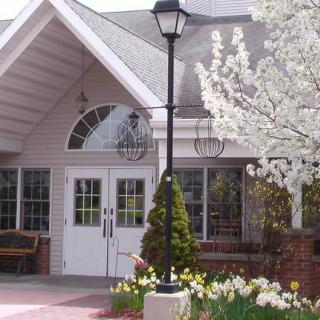
Ashton Place
$2,730 to $3,230 / month10.2 miles away -
from -$470 / mo
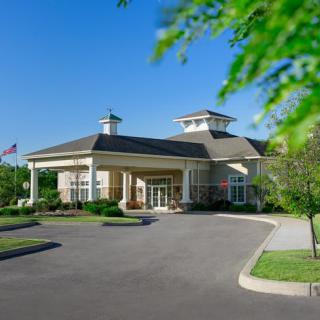
Legacy at Erie Station
$2,295 to $2,795 / month20.9 miles away -
About the same
Parkwood Heights
$2,790 to $3,995 / month13.6 miles away
Overall Review of Ferris Hills at West Lake
Pros
 The reviewer notes that the residents and employees have been amazing in every respect, making the transition comfortable beyond expectations.
- Ferris Hills is a vibrant, active, and caring independent living facility with an optional extended care wing.
- The reviewer would rate Ferris Hills six stars if possible.
- Mom resides at Ferris Hills in a very spacious two-bedroom, two-bath apartment.
- Ferris Hills offers a shuttle service for local trips and hosts a wide range of activities, including lectures, music performances, continuing education courses, card clubs, and games.
- When needed, Ferris Hills provides private car transportation outside the shuttle schedule.
- Ferris Hills is located close to hospitals, medical facilities, and a variety of stores in Canandaigua.
Review
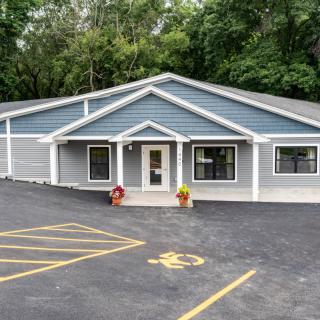
Ferris Hills at West Lake is best suited for active, independently minded seniors who want a vibrant living environment with ready access to supplemental care if needs evolve, all within a Canandaigua setting that emphasizes programming, social connection, and convenient transportation. The community excels for those who value rich cultural and educational offerings, frequent lectures and performances, and a calendar packed with clubs and activities. It is clearly aimed at residents who want to remain engaged, maintain autonomy, and enjoy a sense of community, while knowing there is an optional extended-care wing available should the need for more care arise. In short, this is a strong fit for families seeking a transition-friendly, socially robust independent living option rather than a traditional nursing home.
For families weighing options, it's important to note who may want alternatives. Ferris Hills is not designed to be a full-service medical residence; its strength lies in independence plus flexible support to the extent offered by the extended-care wing. Those whose priorities include round-the-clock on-site medical supervision, memory care with specialized programming, or a more medicalized daily routine should compare with traditional assisted living communities or continuing-care retirement communities that provide stronger 24/7 oversight. Budget constraints are also a practical consideration; if upfront or ongoing costs for a highly comprehensive care continuum are a major factor, other arrangements may offer simpler pricing structures or different value propositions. The community’s location near hospitals and services is a definite plus, but it does not replace the need for continuous clinical care for residents with advanced medical needs.
The strongest pro story here centers on people and programs. Residents benefit from a warm, active culture where staff and peers contribute to a supportive, non-clinical atmosphere that still delivers practical care options when needed. The apartments are described as spacious, with two-bedroom, two-bath layouts that provide real comfort and flexibility for couples or visiting family. Transportation stands out as a standout feature: a regular shuttle to local stores and libraries, plus a private car for trips beyond the schedule. Add in a robust slate of activities, lectures, music performances, continuing education, card clubs, and a broad array of games, and the result is a lifestyle that keeps seniors engaged, connected, and less isolated. Proximity to medical facilities and essential services in Canandaigua further reduces routine logistical friction for residents and families alike.
These strengths offset the main limitations in practical ways, but not perfectly. The most meaningful trade-off is the community’s emphasis on independent living with an optional extended-care option rather than a full-service care environment. For many families, the ability to stay in a roomy apartment, participate in a lively calendar, and access transportation while knowing that additional care can be tapped if necessary represents a compelling path forward. The on-site extended-care wing helps bridge the gap between autonomy and escalating needs, offering reassurance without forcing a move to a higher level of care prematurely. In contrast, for residents requiring continuous, hands-on medical oversight or specialized memory support, the absence of a 24/7 clinical footprint inside the core living space could still feel limiting. Here, the offset comes through the combination of convenient transport, proximity to hospitals, and a community culture that emphasizes well-being and purpose.
Decision-making guidance follows a practical arc. If independence with optional care support and a lively, socially rich environment is the aim, Ferris Hills delivers exceptionally well. Prospective residents should assess the mobility and cognitive profile of the individual, the likelihood of needing more intensive medical services over time, and the willingness to trade some hands-on daily medical supervision for a robust social ecosystem and convenient transportation. For those prioritizing constant clinical oversight, or for families seeking a memory-care-forward model, alternatives that center on comprehensive on-site care will typically offer better alignment. In all cases, a thorough visit and direct conversations about the extended-care wing, staffing ratios, and cost structuring will illuminate how well Ferris Hills aligns with long-term goals.
In sum, Ferris Hills at West Lake represents a practical, well-rounded choice for active seniors who want a high-quality independent living platform with a clear path to more care if needed, backed by strong programming, generous apartment layouts, and dependable transportation. It is less suited for those whose priorities demand continuous clinical care on site. Families considering Ferris Hills should prioritize questions about the scope and cost of the extended-care option, verify the specifics of transportation schedules, and confirm how the community handles evolving care needs as health trajectories change. With those guardrails in place, Ferris Hills offers a compelling combination of lifestyle appeal and practical peace of mind in Canandaigua.
 Independent Living
 Cats allowed
 Dogs allowed
 Activities on-site
 Devotional services off-site
 Indoor common areas
 Ambulatory care
 Diabetic care
 Meals provided




 Top Cars for Senior Drivers and Essential Safety Innovations
 A Closer Look at Private Pay Home Care
 Comprehensive Approaches for Arthritis: A Detailed Guide to Symptoms, Causes, and Care