
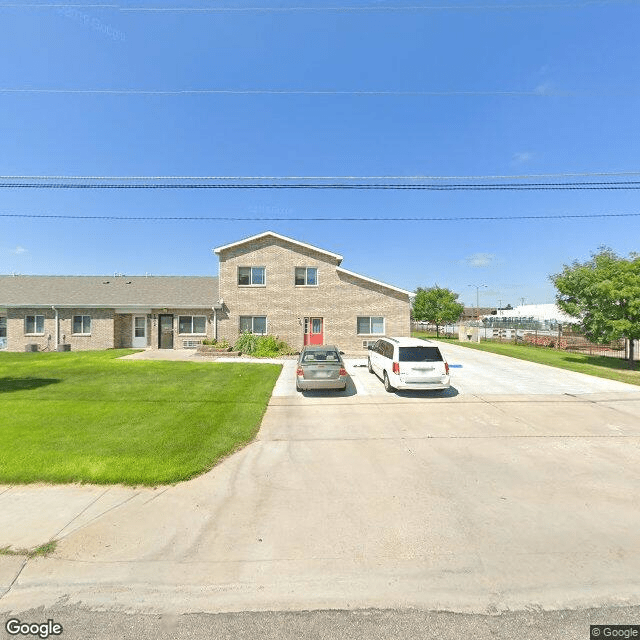
1802 17th Ave, Scottsbluff, NE 69361
To contact a resident: (308) 632-2304
For more information about senior living options: (866) 208-4318
Cirrus House Apartments LLP Assisted Living Costs & Pricing
Cirrus House Apartments LLP Assisted Living offers competitive pricing for its residents, providing a compelling alternative to both county and state averages. For a one-bedroom unit, the monthly rate stands at $1,695, which is significantly lower than Sioux County's average of $2,392 and Nebraska's state average of $3,167. Similarly, the cost for a two-bedroom apartment at Cirrus House is set at $2,195, again offering substantial savings compared to the county's average of $3,008 and the state's higher rate of $3,627. These appealing rates reflect Cirrus House's commitment to delivering quality assisted living while ensuring affordability for its residents.
| Floor plans | Cirrus House Apartments LLP Assisted Living | Sioux County | Nebraska |
|---|---|---|---|
| 1 Bedroom | $1,695 | $2,392 | $3,167 |
| 2 Bedrooms | $2,195 | $3,008 | $3,627 |
Overall Review of Cirrus House Apartments LLP Assisted Living
Pros
 The program provides great help for people with mental illnesses, including training, housing, therapy, and life skills.
- Brent and Marcia are described as the best.
- New arrivals are welcomed and feel at home.
- Individuals continue to volunteer for years, showing lasting commitment.
- The place is said to be the best place on earth.
- The staff are very helpful and friendly.
- Therapists Marcia Estrada, Brent Anderson, and Kendra Dean are praised for their support.
- The community helps people fit right in.
Cons
 The staff aren’t that good.
- The staff are very burnt out and have no idea how to handle their clients, and they push the work onto other staff.
- There is poor management overall and a need for new, more dedicated people in charge.
Review
Cirrus House Apartments LLP Assisted Living in Scottsbluff is best suited for adults who need structured supports around mental-health challenges, not merely daytime socialization. The community earns its keep by delivering housing, therapy, and life-skills coaching in a setting that residents describe as welcoming and home-like. The strongest signal from the reviews is that a collaborative team, especially clinicians and coaches like Brent, Marcia, and Kendra, can become a trusted, long-term anchor. For someone who benefits from ongoing therapeutic relationships, steady routines, and a place where recovery is treated as an active, supported process, Cirrus House offers a coherent, purpose-driven environment.
Those who may want alternatives are clear: families seeking a traditional, less specialized assisted-living experience with uniform medical oversight and less emphasis on mental-health programming should look elsewhere. If the priority is a more conventional care model with consistent staffing across shifts, or if the resident requires higher levels of medical supervision or a broader menu of clinical services beyond housing, therapy, and life skills, several other communities may suit better. Additionally, anyone wary of variability in staffing quality or administrative direction should scrutinize Cirrus House closely before committing, since management dynamics show up as a notable risk in the feedback.
On the positive side, the core offerings at Cirrus House align closely with the needs of its residents. The reviews repeatedly highlight practical supports: training, housing, therapy, and life skills, an integrated package that reduces barriers to independence while maintaining safety. The staff are described as helpful and friendly, with specific gratitude directed toward therapists who foster a sense of belonging. The emotional payoff is tangible: people feel welcomed, and several ex-residents express enduring loyalty, even volunteering years after beginning services. When a program can translate professional care into genuine community belonging, that is a meaningful offset to logistical friction.
The principal downside centers on staffing quality and management stability. One review explicitly notes that staff aren’t consistently strong and that burnout is visible, with work being shifted between team members. The same critique points to poor management and a need for more dedicated leadership. In practical terms, this suggests the risk of uneven care continuity, potential delays in responses, and inconsistent execution of even well-designed programs. For families, those are not small concerns, because even a strong therapeutic framework relies on steady, capable hands to translate plans into day-to-day support.
How the positives offset the negatives comes down to alignment of needs and expectations. If the resident’s primary goal is sustained engagement in therapy, skill-building, and a community that treats recovery as ongoing work, Cirrus House can deliver disproportionately high value despite leadership gaps. The warmth of the community, the long-standing involvement of trusted therapists, and the sense of belonging cultivated by staff and volunteers make a meaningful difference in daily life. However, if administrative reliability, uniform staff performance, and predictable response times are non-negotiables, these drawbacks warrant caution and thorough due diligence during a visit.
In the end, Cirrus House serves a distinct niche well: adults seeking a therapeutic, community-centered environment where housing, coaching, and mental-health supports coalesce around a recovery-oriented lifestyle. It is a prudent choice for families prioritizing ongoing therapy access and a home-like atmosphere over pristine administrative polish. Those who would rather see more uniform staffing, clearer leadership accountability, and steadier day-to-day operations should compare it with options that emphasize centralized management and consistent staffing protocols. For the right resident, Cirrus House can be not just a residence but a stabilizing, empowering stepping-stone toward greater independence.
 Assisted Living
 Activities on-site
 Devotional services off-site
 Indoor common areas
 Ambulatory care
 Diabetic care
 Meals provided



 Social Security Benefits and Assisted Living: Navigating Options Across the U.S.
 An Extensive Exploration of the VA Aid and Attendance Benefit
 Senior Transition Services: Understanding Their Role, Cost, and Importance