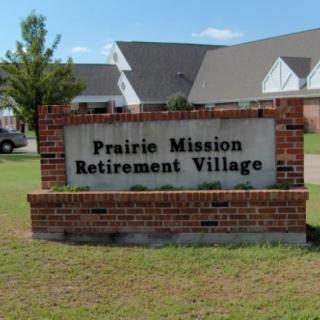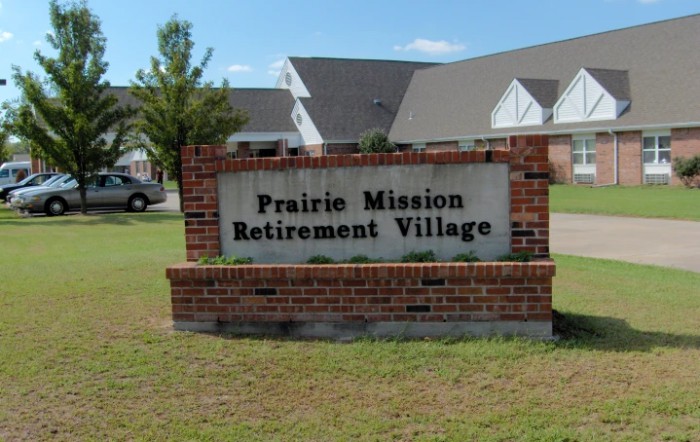
242 Carroll Street, Saint Paul, KS 66771
For more information about senior living options: (866) 208-4318
Overall Review of Prairie Mission Retirement Village
Pros
 The care provided is described as the best the family has ever seen.
- Prairie Mission is a hospitable facility with a homier atmosphere than other assisted living facilities.
- Residents receive ample one-on-one time and are made to feel at home.
- There are many activities that keep residents active and socially connected.
- The therapists are top notch, delivering consistent daily sessions.
- Families feel their loved ones receive a loving, caring atmosphere at Prairie Mission.
Cons
 The reviewer notes that moving from one’s own home to an assisted living facility can be a difficult transition.
- The reviewer suggests that other homes have not been as caring and loving as Prairie Mission.
Review
Prairie Mission Retirement Village in Saint Paul, Kansas is best suited for families seeking a warm, home-like assisted-living environment where residents receive attentive, relationship-driven care and deliberate rehabilitation support. It serves seniors who no longer can fully manage daily tasks but still thrive in a small-community setting with plenty of one-on-one interaction. The emphasis on personal attention, genuine kindness from staff, and a culture that feels like a close-knit home makes it an especially strong fit for residents who value steady routines, meaningful activities, and consistent caregiver relationships. For families prioritizing a bright, emotionally supportive atmosphere over a flashy campus, Prairie Mission delivers tangible daily comfort and connection.
Careful consideration should be given to those with higher medical acuity or specialized memory support. If 24/7 clinical nursing oversight, advanced wound care, or dementia-specific programming with dedicated secure spaces is nonnegotiable, alternatives with larger staff coverage or a licensed memory-care unit may be more appropriate. Similarly, families seeking a broad hospital-style campus with extensive on-site services and numerous offshoot amenities might find calmer, smaller settings like Prairie Mission less aligned with expectations. The reviews point to a highly relational, therapy-forward model, which is excellent for many, but those needing complex medical protocols on a constant basis should compare options with stronger nursing capacity.
From the resident experiences, the primary strengths are unmistakable: a hospitable, homelike ambience; staff who greet residents warmly; abundant activities that foster social connection; and therapists who deliver hands-on, regular rehabilitation. These elements combine to produce observable gains, one reviewer cited a father-in-law progressing from wheelchair to cane after daily therapy, six days a week. That kind of practical, measurable progress is rare enough to count as a major pro. The strongest appeal is the sense that care is personal and sustained, with families noting that the staff clearly loves and advocates for the residents.
Those advantages offset several potential caveats by centering daily experience on relationship and routine rather than sheer volume of services. The tightly focused environment reduces confusion and promotes trust, which is invaluable for seniors who fear change. The explicit emphasis on enjoyable activities and regular interaction helps mitigate isolation, a common risk in smaller facilities. While the available evidence comes from a small number of positive testimonials, the consistency of warmth, attention, and visible therapy results suggests Prairie Mission can outperform larger, impersonal settings for residents who fit the profile. In this sense, the pros do more than compensate for the lack of breadth in services.
Decision-makers should approach with a practical checklist: verify current nursing ratios and on-site medical coverage; ask about dementia-care options and staff training in memory care; tour the therapy spaces and confirm the frequency and timing of sessions; review meals and daily schedules to ensure they align with a loved one’s preferences; and speak with current residents or families about long-term satisfaction. If possible, arrange a short-term stay or respite to observe daily rhythms and interaction quality firsthand. Also compare costs and what is included, so the value of personal attention versus the campus size can be weighed clearly.
When the priority is a compassionate, family-like atmosphere paired with robust rehabilitative engagement, Prairie Mission Retirement Village stands out as a strong choice for Saint Paul-area seniors who no longer live independently but do not require 24/7 hospital-grade care. It is particularly well-suited for residents who respond well to structured activities, frequent human interaction, and therapy-led improvement. However, for anyone whose needs center on complex medical monitoring or dementia-specific care in a larger, more clinical setting, alternatives should be pursued. Weighing the warmth and therapy-focused strengths against the breadth of services will guide a confident, tailored decision.
 52 resident community capacity
 Assisted Living
 Continuing Care Retirement Community (CCRC)
 Independent Living
 Memory Care
 Skilled Nursing Facility
 Air-conditioning
 Beauty salon
 Cable or satellite TV
 Computer center
 Fitness room
 Fully furnished
 Gaming room
 Garden
 Housekeeping services
 Kitchenette
 Move-in coordination
 Outdoor space
 Private bathrooms
 Restaurant-style dining
 Small library
 Telephone
 Wellness center
 Wi-Fi/high-speed internet available
 Community operated transportation
 24-hour call system
 Activities of daily living assistance
 Assistance with bathing
 Assistance with dressing
 Assistance with transfers
 Diabetes diet
 Medication management
 Special dietary restrictions
 Concierge services
 Planned day trips




 Understanding the Distinctions: Assisted Living and Memory Care Explained
 How to Communicate with a Loved One Living with Dementia: 10 Supportive Strategies
 Comprehensive Guide to VA Nursing Homes: A Crucial Long-Term Care Resource for Veterans