
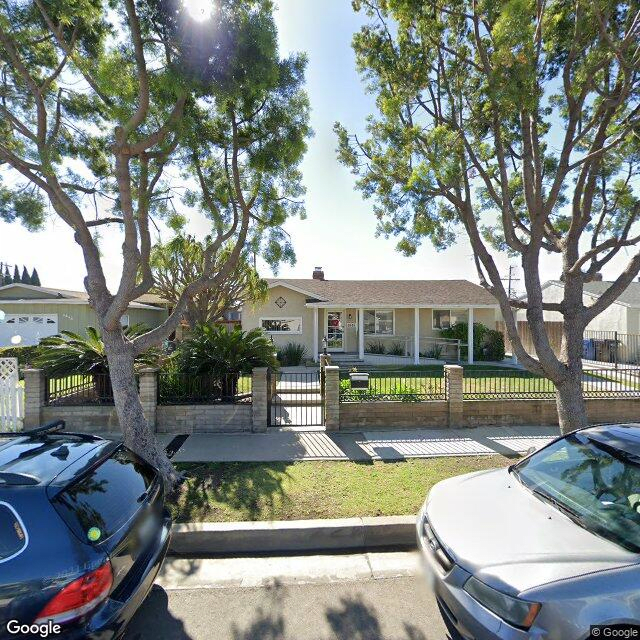
4848 W 134th Place, Hawthorne, CA 90250
To contact a resident: (310) 489-2764
For more information about senior living options: (866) 208-4318
A Helping Hand Costs & Pricing
A Helping Hand's monthly costs for room types are notably positioned within the broader landscape of Los Angeles County and California at large. For a semi-private room, A Helping Hand charges $4,500, which is significantly higher than the county average of $3,349 and the state average of $3,333. Conversely, in the private room category, A Helping Hand's fee stands at $4,800 - again above both Los Angeles County's average of $4,197 and California's state average of $3,939. These figures suggest that while A Helping Hand may be priced at a premium compared to local and statewide competitors, they likely offer specialized services or accommodations that justify this difference in cost.
| Floor plans | A Helping Hand | Los Angeles County | California |
|---|---|---|---|
| Semi-Private | $4,500 | $3,349 | $3,333 |
| Private | $4,800 | $4,197 | $3,939 |
Senior living communities with a similar price nearby
-
from -$500 / mo
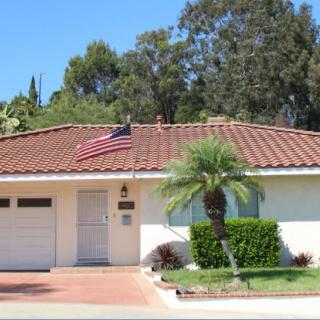
Palomino Residential Care
$4,000 to $6,000 / month16.1 miles away -
from -$500 / mo
Loving Care Facility for the Elderly
$4,000 to $5,975 / month23.5 miles away -
About the same
Bauer Assisted Living
$4,500 to $6,500 / month23.3 miles away -
from +$500 / mo

Sweet Home Senior Living #1
$5,000 to $7,500 / month18.8 miles away -
About the same
Ardenville Home Care I
$4,500 / month20.9 miles away
Overall Review of A Helping Hand
Pros
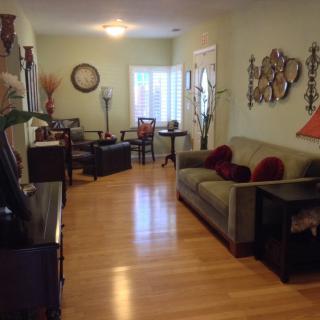
 A Helping Hand is immaculately clean and comfortably furnished for six residents.
- The home provides a stimulating daily rhythm with an activity guide, a piano player, and volunteer visitors.
- The staff are gentle and compassionate, offering snacks, conversation, a home-cooked meal, and a blanket for TV watchers.
- Family members and friends are welcome to visit anytime to enjoy coffee or a game with their loved one, just like home.
- Sue Cooper hosts get-togethers throughout the year that give residents and their families a sense of community.
- A Helping Hand is truly a home away from home.
Review
A Helping Hand in Hawthorne, CA is best suited for families seeking a warm, intimate alternative to large, impersonal assisted-living communities. The home accommodates six residents and is guided by owner Sue Cooper, delivering day-to-day life with personal attention, continuity, and dignity. It works particularly well for seniors who respond to routine, companionship, and a sense of community, and for families that value easy, frequent visits, home-cooked meals, and memory-friendly engagement. The environment is designed to feel like a true home rather than a facility, with gentle staff interactions, familiar routines, and ongoing activities that keep residents socially involved.
This configuration is not for everyone. For residents requiring robust medical oversight, 24/7 skilled nursing, or highly specialized memory-care programming, a larger, more clinically equipped community would be a wiser match. The small home setting, while rich in personal attention, naturally limits on-site medical staffing and specialized equipment. Families should also consider preferences for privacy and space; six residents means fewer private rooms and more shared living areas. Those with complex medication regimens or high fall risk may prefer a setting with structured clinical protocols and round-the-clock supervision.
Key pros center on a meticulously clean, comfortably furnished environment that mirrors a private home. The six-resident footprint enables incredibly individualized care, where caregivers know preferences, routines, and histories. The care team is described as gentle and compassionate, delivering everyday moments that matter: snacks, conversation, home-cooked meals, and blankets for a TV vigil. Social stimulation is built in through an activity guide, a piano player, volunteers, and regular, family-hosted gatherings that knit residents into a genuine community. This blend of intimacy and engagement supports emotional and cognitive well-being, especially for residents with dementia who still respond to familiar songs and conversations.
The main drawbacks stem from the reliance on a small owner-operator model and a limited staff pool. After-hours coverage can be thinner, and response times in medical changes may depend on external providers rather than on-site professionals. The intimate setting may also fall short for residents needing extensive medical services, therapies, or equipment typical of larger campuses. For some families, privacy considerations or a preference for private apartments may steer them toward a larger community with more defined accommodations.
Despite these caveats, the strengths align strongly with families prioritizing connection and dignity. The homelike ambiance and open invitation for family involvement create emotional steadiness and a sense of belonging that is hard to match in bigger facilities. A devoted team, with direct involvement from the owner, tends to deliver personalized adjustments to care plans and daily routines, fostering trust and predictability. The social calendar, celebrations, reminiscence, and shared meals, provides meaningful purpose and reduces isolation, particularly for residents facing memory loss who still cherish personal identity and community ties.
In practical terms, this community is a compelling choice for those who want a close-knit, neighborhood-like residence where residents are treated as neighbors, not numbers. It excels for families seeking daily human connection, predictable routines, and robust family engagement. It is less well suited for seniors who require constant clinical supervision, high-level memory-care programming, or the scale and resources of a large campus. Prospective residents should visit, meet Sue Cooper and the care team, observe day-to-day interactions, and ask about staffing patterns, medication management, and emergency protocols. If a home-like setting with active community involvement ranks highest, A Helping Hand earns the top recommendation.
 Board and Care Home
 Cats allowed
 Dogs allowed
 Private
 Los Angeles International (3 miles away)
 Ambulatory care
 Incontinence care

 In-Depth Look at the VA Aid and Attendance Program
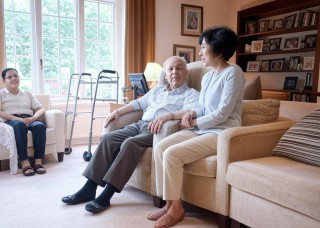 Nurturing Our Loved Ones: A Daughter's Journey in Caring for Her Mother
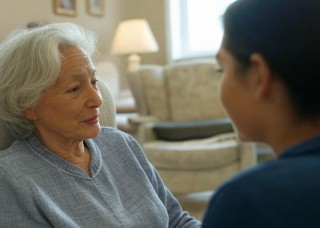 Nurturing Our Elders: Linda's Journey of Supporting Her Mother