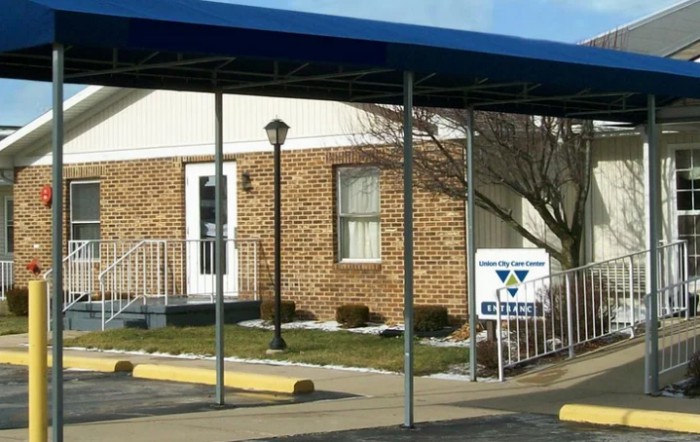
907 East Central Street, Union City, OH 45390
For more information about senior living options: (866) 208-4318
Overall Review of Union City Care Center
Pros
 They love everyone there.
- It is a very nice place.
- The nursing staff is above average.
Cons
 The facility allegedly treats long-time residents differently from short-term ones.
- It is described as a low-cost option for Medicaid with few private-pay patients.
- It reportedly refused to honor the primary care physician’s dietary plans, claiming only one diet could be provided to save costs.
- It barely qualifies as full-service rehab; most equipment doesn’t work and the furniture worsens conditions.
- Therapists are certified but allegedly lack advanced degrees and rely on subcontractors to evaluate patients.
- Sanitation concerns include one bathroom shared by four or more people and inconsistent room cleaning and linen changes.
- Theft of clothes and hangers was reported, and when errors occurred they were often ignored rather than apologized for.
- Meal options are limited, with inadequate provision of appropriate meals for diabetics and other serious medical needs.
Review
Union City Care Center is best suited for families navigating tight budgets and Medicaid-like payment options who need straightforward, ongoing assistance rather than high-intensity rehab or boutique-level services. It works for residents who can tolerate uneven service quality, a basic rehabilitation footprint, and a setting where daily care and supervision are the primary value rather than premium amenities. Those with complex medical diets, strict dietary plans, or expectations of consistently pristine housekeeping should look elsewhere. In short, it serves as a practical, low-cost option for stable, low-to-moderate care needs, not a center designed for top-tier clinical outcomes.
On the upside, the center’s strongest selling point is cost, the kind of affordability that appeals to Medicaid-funded placements. Several reviewers describe the facility as a low-cost option within the region, which is meaningful for families with budget constraints. Nursing staff is frequently cited as above average, providing a steady, dependable level of attention day to day. A number of residents and family members also report a generally positive, welcoming atmosphere among the staff, which matters for comfort and routine in long-term care.
However, the most consequential drawbacks undermine the overall value. Rehab services, while advertised as full, come up short in practice, with reviewers characterizing them as limited in scope and effectiveness. Equipment often fails to function properly, and furniture use can aggravate medical conditions rather than aid recovery. Therapists are certified but not highly credentialed, leaning on subcontractors rather than in-house specialists. The gap between claim and reality here is sizable and directly affects outcomes for any resident whose goal is meaningful rehabilitation or recovery.
Sanitation and daily operations present another and more troubling set of failures. One bathroom shared by four or more residents highlights a cascading risk to hygiene and comfort, while frequent lapses in room cleaning and linen changes create an environment that hardly supports dignity or ease of living. Theft of clothes and hangers further erodes trust and safety, and the most basic expectations, timely housekeeping, respectful handling of personal belongings, and prompt acknowledgment of errors, are not consistently met. Meal offerings are limited, and there is clear dissatisfaction that dietary needs, especially for diabetics or other conditions, may not be properly accommodated. Taken together, these operational weaknesses significantly color the perceived quality of care.
The gaps in daily care and the questionable rehab capabilities do not vanish simply because the staff is friendly. The pros, lower cost and a caring nursing presence, can offset some day-to-day burdens for residents who do not require intensive therapy or meticulous dietary oversight. Yet the scale tips away from value for long-term custodial needs when sanitation, accountability, and reliable rehabilitation are on the line. For families weighing options, this means Union City Care Center may be tolerable as a last resort or a short-term stop for someone with minimal medical complexity, but it is a risky baseline for sustained, high-quality living where safety, nutrition, and rehabilitative progress are nonnegotiable.
Those evaluating alternatives should parse several red flags and probe aggressively before committing. If priority is reliable post-acute rehab, rigorous dietary management, pristine housekeeping, and responsive administration, other communities deserve consideration. Prospective residents with complex medical diets, strong needs for wound, diabetic, or mobility-specific care, or those who prize private bathrooms and consistently clean environments should look elsewhere. Even in the brightest moments, the person entering Union City Care Center should plan for ongoing oversight by family or guardian, with a clear exit strategy if the facility fails to meet evolving care requirements.
In sum, Union City Care Center offers affordability and a basic, compassionate nursing presence, but it falls short on rehab depth, hygiene discipline, and operational reliability. Families leaning toward cost-first decisions may find it acceptable, yet it is essential to verify that the center’s capabilities align with the resident’s needs, especially around rehabilitation potential, dietary support, and housekeeping standards. Before placing a loved one, demand concrete assurances on rehab programming, dietary accommodations, room maintenance, and a transparent plan for handling errors or theft. If those assurances cannot be documented, alternatives should be pursued promptly.
 43 resident community capacity
 Skilled Nursing Facility
 Beauty salon
 Cable or satellite TV
 Dining room
 Fully furnished
 Garden
 Housekeeping services
 Kitchenette
 Move-in coordination
 Outdoor space
 Restaurant-style dining
 Small library
 Telephone
 Wi-Fi/high-speed internet available
 24-hour call system
 Activities of daily living assistance
 Assistance with bathing
 Assistance with dressing
 Assistance with transfers
 Diabetes diet
 Medication management
 Mental wellness program
 Special dietary restrictions








 Comprehensive Guide to Qualifying for Home Health Care Services
 Powerful Realities of Elder Abuse and the Most Effective Ways to Report It
 Ten Vital Duties of a Senior Caregiver: A Comprehensive Guide