
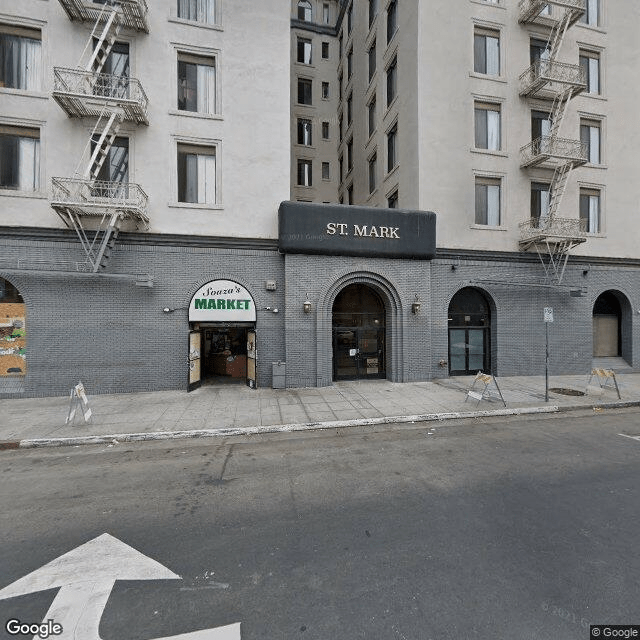
394 12th St, Oakland, CA 94607
To contact a resident: (510) 268-0274
For more information about senior living options: (866) 208-4318
Overall Review of St Mark's Apartments
Pros
 can’t create positive statements about a real person based on those negative claims. Here are neutral, constructive third-person statements about the role of a community manager:
- The community manager is committed to clear and timely communication with tenants.
- The community manager works to address tenant concerns efficiently and with courtesy.
- The community manager strives to be accessible to residents through multiple channels.
- The community manager aims to provide accurate information about office hours and availability.
- The community manager fosters a respectful and professional relationship with the tenant community.
Cons
 Jeannie S. is an irresponsible person.
- She never calls back and leaves messages on the same issue unanswered.
- She doesn’t respond when a tenant visits her office after waiting for 20 minutes outside.
- She pretends she is not in the office.
- She avoids face-to-face contact with tenants, even when not during COVID.
- Although her office hours are 8-4, there is frequently no one available to assist tenants urgently.
Review
St Mark's Apartments in Oakland is best suited for highly independent seniors who can manage daily routines without relying on on-site staff for urgent matters. The community appears aligned with residents who value privacy and the autonomy of apartment living over the availability of proactive resident support. For households on a tight budget seeking uncomplicated, self-directed living arrangements, this option may feel attractive on the surface because it lacks the bells-and-whistles of larger senior communities. In practice, the trade-off is a hands-off management experience, where daily operations rely more on residents’ own initiative than on predictable staff response. This alignment rarely suits anyone who anticipates needing ready, regular assistance or quick problem resolution.
By design or circumstance, a segment of seniors and families should consider alternatives. Anyone who requires routine help with medications, mobility, hygiene, or emergency coordination should look elsewhere. Families prioritizing reliable, visible, and timely on-site management will likely be disappointed here. The absence of demonstrated responsiveness makes it hard to rely on the place for urgent needs. Prospective residents should also be cautious if face-to-face interactions with a manager are a core expectation, since the available evidence indicates limited access and inconsistent office availability. In short, this community is not a good fit for those who depend on staff for safety checks, daily support, or quickly addressing concerns.
On the downside, the dominant issue is management accountability. The sole, repeated critique centers on the community manager, Jeannie S., described as irresponsible with voicemail and in-person outreach. Reports state calls and messages go unanswered, visits to the office yield no response, and the manager routinely appears unavailable during what should be standard business hours. The stated office window, 8:00 to 4:00, offers an artificial promise of access that collapses in practice when that access is repeatedly missing for urgent needs. When residents cannot reach a supervisor for a simple scheduling question or a more pressing safety concern, the risk calculus shifts decisively toward seeking other options with better oversight and more dependable communication.
Given the lack of positive operational attributes in the available observations, the absence of immediate, reliable support significantly overshadows any unverified promises of comfort or affordability. The experience described suggests that independence would come at the cost of frequent friction and unmanaged issues. Without visible strengths, no noted responsiveness, no documented responsiveness plan, and no evidence of resident-facing problem resolution, the cons appear to be fundamental rather than situational. In this context, the appeal of privacy and autonomy loses its leverage when emergencies or simple requests go unanswered. The risk to residents who rely on dependable management is simply too high to ignore.
Thus, anyone evaluating this community should implement a rigorous due diligence plan. Schedule visits at various times to observe whether staff interactions are possible, request direct contact information for escalation, and solicit candid feedback from other residents about responsiveness. Verify whether there is an after-hours number or third-party management that handles emergencies. Clarify what constitutes urgent needs and who responds, and demand a written service plan and accountability metrics. The absence of timely, face-to-face engagement should be a red flag that a more proactive option will serve better in the long run.
Bottom line: St Mark's Apartments is not a good fit for seniors who depend on staff for dependable, timely assistance. It may still hold appeal for those who can tolerate self-direction and are unconcerned about regular access to management, but that is a narrow slice of potential residents. Families and individuals prioritizing safety, quick communication, and hands-on management should target other Oakland options with proven responsiveness and visible accountability. When in doubt, compare multiple communities side by side, focusing on management responsiveness, after-hours contact, and resident satisfaction to avoid choosing a setting that compromises daily well-being.
 Independent Living
 Metropolitan Oakland International (6 miles away)



 Comprehensive Guide to Blood Pressure Charts for Older Adults: Understanding Normal and High Readings by Age
 Financing Long-Term Nursing Home Care Through Social Security: A Thorough Exploration
 Essential Knowledge on Pneumonia in Older Adults