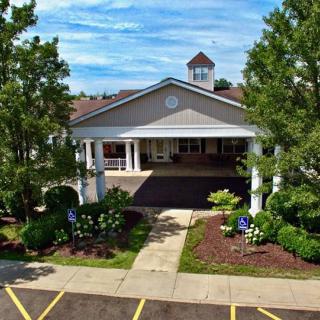
889 N Aurora Road, Aurora, OH 44202
To contact a resident: (330) 562-6171
For more information about senior living options: (866) 208-4318
The Campus of Anna Maria Costs & Pricing
The Campus of Anna Maria offers a range of accommodation options that reflect varying costs compared to both Summit County and broader Ohio averages. For a studio apartment, residents can expect a monthly fee of $3,870, which is competitively positioned below Summit County's average of $4,012 while slightly exceeding the state average of $3,727. In terms of one-bedroom units, the cost at Anna Maria is $4,350, notably higher than the $3,849 found in Summit County and marginally above Ohio's average of $3,712. The pricing for two-bedroom apartments stands at $4,950, which is more substantial compared to both Summit County ($4,103) and Ohio's average ($3,501). Overall, The Campus of Anna Maria presents an appealing yet premium option within the local housing market.
| Floor plans | The Campus of Anna Maria | Summit County | Ohio |
|---|---|---|---|
| Studio | $3,870 | $4,012 | $3,727 |
| 1 Bedroom | $4,350 | $3,849 | $3,712 |
| 2 Bedrooms | $4,950 | $4,103 | $3,501 |
Assisted Living communities with a similar price nearby
-
from +$330 / mo
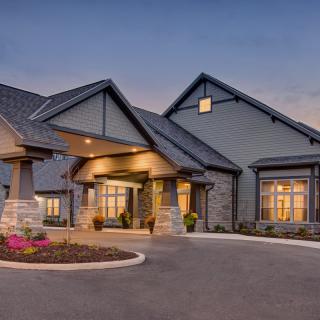
Maplewood At Cuyahoga Falls
$4,200 to $5,500 / month14.7 miles away -
from +$125 / mo
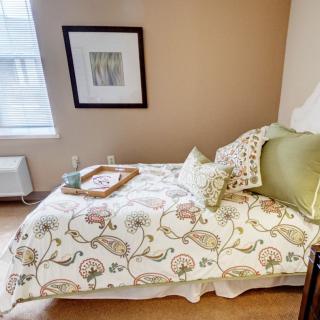
Vista Veranda
$3,995 to $5,495 / month13.7 miles away -
from +$210 / mo
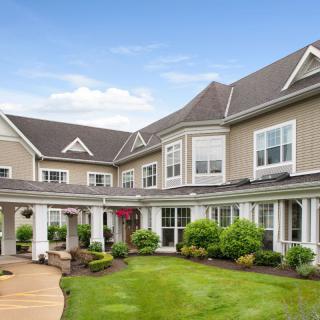
Sunrise of Cuyahoga Falls
$4,080 to $5,610 / month16.6 miles away -
from +$124 / mo
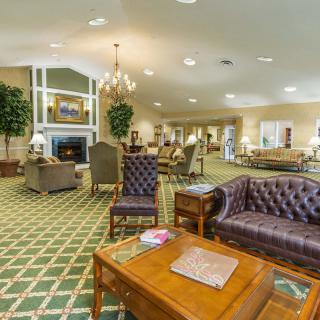
Independence Village Of Aurora
$3,994 to $5,639 / month3.0 miles away -
from -$770 / mo
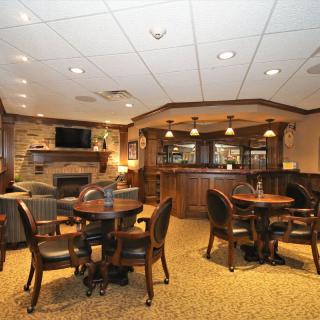
The Inn at Apple Ridge
$3,100 to $4,500 / month16.1 miles away
Overall Review of The Campus of Anna Maria
Pros
 The location works well for residents needing rehab and skilled nursing.
- The community is very professional and resident-centered.
- The campus is large and well-organized.
- The staff are friendly and helpful, and residents participate in social activities.
- The community is a nice place, leaving a positive impression on visitors.
- Families gain peace of mind knowing their loved ones are in a secure environment.
- The meals are good, contributing to overall satisfaction with care.
Cons
 The memory unit is located at the back of the community and is not easily accessible.
- The community isn't as new as other facilities.
- One resident had only a toilet and sink, not a full bathroom.
- There are many roommate situations in the memory care unit.
- The community is not nonprofit.
Review
The Campus of Anna Maria is best suited for families seeking a large, campus-style setting where rehab, skilled nursing, and memory care are all available under one roof, with a professional, resident-centered approach as the core operating principle. It works especially well for seniors who need post-acute rehab and ongoing support, plus structured memory-care programming, and for families who value a visible dedication to safety, activity, and social engagement within a cohesive community. The Aurora, Ohio location matters: the site offers convenient access for visits and longer-term continuity of care, which matters when transitions between services are frequent or when a loved one needs steady supervision and coordinated therapy.
Those who may want to consider alternatives should note a few red flags. Nonprofit seekers or cost-conscious families may prefer other operators, since this campus is not nonprofit and long-term affordability can differ from nonprofit models. If the goal is a smaller, quieter, more intimate setting, look elsewhere; the campus feel can feel expansive and the memory-care wing is tucked away at the back, which adds a layer of layout complexity. For families prioritizing a memory unit with easy central access and more private, single-occupancy accommodations, this option may not be the best match. In short, those chasing the sleekest, newest finishes or private baths across the board may want to benchmark alternatives before committing.
The strongest positives are concrete and meaningful: professional, resident-centered care is repeatedly highlighted, with staff who are responsive and focused on the person in front of them. The campus supports rehab and skilled nursing needs with an integrated team, which often translates to smoother transitions and continuity of care. Residents benefit from a bustling calendar of activities and social opportunities, and feedback on food is favorable. This combination, clinical capability on a single, organized campus plus an active, engaged environment, provides a practical pathway to peace of mind for families worried about ongoing health needs, safety, and meaningful daily engagement for a loved one.
But the layout and room configurations temper those strengths. The memory-care unit sits toward the back of the complex, making routine access less convenient and potentially complicating navigation for visitors and residents alike. Some memory-care accommodations involve shared bathrooms and a higher prevalence of roommate arrangements, which can be challenging for those prioritizing privacy or individual living space. The facility, while solid, is not among the newer builds, and that older infrastructure can influence comfort levels for residents and families who prefer the latest finishes or more modern amenities. These factors don’t erase the care quality, but they are real considerations that can affect daily living rhythms.
From a family’s perspective, there are compelling outcomes that reinforce the decision to choose Anna Maria. Families relocating loved ones report stronger care experiences and greater peace of mind, especially when a move brings more robust supervision, therapy options, and structured social programming. Residents appear to engage, participating in activities, socializing, and maintaining a degree of routine that supports mood and function. Positive impressions extend to staff demeanor and responsiveness; when the goal is reliable caregiving and consistent visitation support, the campus delivers. The combination of clinical capability and visible community life translates into practical advantages for daily living and long-term planning.
In the end, the choice hinges on balance. The Campus of Anna Maria offers a practical, dependable solution for seniors who require rehab, skilled nursing, and memory care within a single, organized campus and who prize a professional, resident-first culture. It is especially well-matched for families prioritizing location, safety, ongoing therapy, and social engagement over the nicher appeals of newer construction or ultra-private memory-care arrangements. Those who will want to consider alternatives are families seeking nonprofit operation, easier cross-campus access to memory care, or more private, contemporary accommodations. For the right family, this campus can deliver both clinical confidence and daily vitality, with clear peace of mind about a loved one’s care trajectory.
 Assisted Living
 Cats allowed
 Dogs allowed
 Activities off-site
 Air-conditioning
 Beautician on-site
 Cable or satellite TV
 Devotional services off-site
 Full kitchen
 Ground floor units
 Handicap accessible
 Indoor common areas
 Outdoor common areas
 Respite or short term stays offered
 Wheelchair accessible showers
 Wi-Fi/high-speed internet available
 Ambulatory care
 Diabetic care
 High acuity care
 Incontinence care
 Medication management
 Gluten-free
 Catholic services
 Cooking classes
 Day trips and outings
 Educational speakers / life long learning
 Happy hour
 Karaoke
 Live well programs
 Wine tasting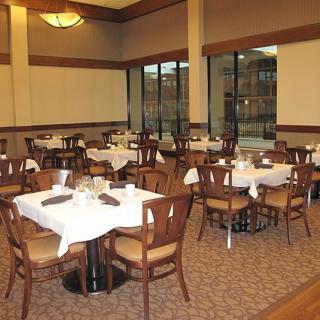
 Beyond the Bingo Hall: 50+ Enriching Activities for Seniors in Assisted Living
 Understanding the Distinctions: Assisted Living and Memory Care Explained
 Guiding Elderly Parents Who Refuse Assisted Living: 6 Practical Steps