
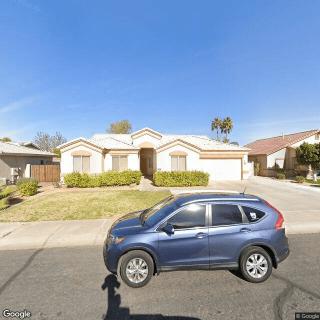
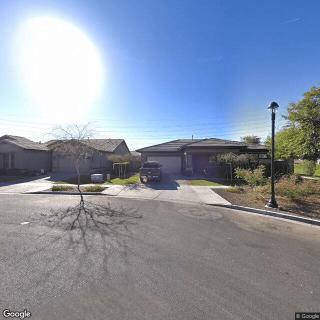
6842 East Posada Circle, Mesa, AZ 85202
For more information about senior living options: (866) 208-4318
Overall Review of Mels Tlc
Pros
 American Orchards provides excellent, quality care.
- All of the employees are friendly, helpful, and show genuine concern for the resident’s wellbeing.
- The facility offers quality meals with many choices.
- The resident is kept in new, clean clothes every day.
- Caregivers look in on the resident, take time to visit and talk, watch TV with her, and make her feel loved.
- American Orchards has an on-site nurse available 24/7.
- There is prompt communication, with staff available to discuss questions or concerns and typically replying within a few hours.
- The reviewer would highly recommend American Orchards.
Cons
 The reviews describe American Orchards as very disappointing and an absolutely awful experience.
- The community relations, director, and marketing staff are said to be unable or unwilling to provide honest, straightforward answers about facility requirements.
- They are described as taking visitors on tours to show how wonderful the facility would be, then stonewalling when details about staying there are asked.
- The responses given are considered contradictory and arbitrary, and they dismiss you and move on.
- They show little thought for how their treatment affects those seeking help for a loved one who can no longer care for themselves.
- On the surface the facility seems ideal, but if it is not honest and upfront from the beginning, that is a bad sign of how it is run.
Review
This community is best suited for families seeking memory-care support where visible, hands-on caregiving and steady, reliable family communication are non-negotiables. The most compelling fit shows up for those who value a caregiver presence that translates into daily routines, personal attention, and timely updates about a loved one’s condition. It may not be the right match for households that require crystal-clear, immediately satisfied admission criteria and a frictionless information flow from first inquiry to move-in. For those with tighter budgets or a insistence on transparent policies from the outset, alternatives in the Mesa area deserve strong consideration.
The favorable side of the feedback highlights a level of care that feels practical and tangible when it comes to daily life. One reviewer notes an on-site nurse available around the clock, consistently friendly staff, and dependable communication about a resident’s wellbeing. The emphasis on good meals, clean clothes, and caregivers who genuinely engage, sitting with a resident, chatting, and staying connected, paints a scene of a warm, attentive environment. For families who measure value by continuous caregiving presence and regular touchpoints, these factors can translate into real peace of mind and less day-to-day worry.
Yet the flip side of the narrative cannot be ignored. A separate, damning account centers on transparency and policy clarity, describing experiences where questions about facility requirements and admission criteria were met with evasiveness or contradictory answers. The reviewer characterizes interactions with operations leadership as dismissive, with the impression that tours are promotional rather than informative, and with a general sense of stonewalling when details matter for decision making. In memory care, where every decision hinges on concrete criteria and predictable processes, such experiences carry substantial risk and can undermine confidence in choosing a community.
The core tension between these two viewpoints is what ultimately tests the community’s value proposition. If the positive attributes, constant nursing oversight, reliable staff engagement, and meaningful family contact, can be consistently delivered and, ideally, documented in clear policies, the higher price tag and occasional friction may be justified. The offset is measured not only in resident well-being but in family serenity: knowing there is a steady point of contact, a defined care plan, and a routine that reduces uncertainty during a fraught period.
For families weighing options, several guardrails emerge. Seek written, specifics-driven documentation on the memory-care program: admission criteria, care-plan development, staffing ratios, nurse availability, and escalation protocols. Demand direct conversations with a facility leader about what constitutes “excellent” memory care at this community and ask for named references from other families who have moved through the process. Look for a transparent tour experience that answers concrete questions rather than glossing over potential gaps. If the response to these asks remains opaque, or if promises are not backed by written policies, alternatives with clearer governance become more attractive.
In the end, this type of community can deliver real value for memory-care needs when the care is consistently hands-on and the care-planning process is transparent and responsive. The strongest endorsement comes from families that see visible staffing engagement, timely updates, and a Nurse-on-site reality matched by clear, written criteria and predictable decision-making. If these elements are present or can be secured through a candid leadership discussion and solid references, the facility offers solid protection against the kind of stress that often accompanies memory-care transitions. If not, families should favor options where transparency, firmness of admissions criteria, and proactive communication are non-negotiables from day one.
 5 resident community capacity
 Assisted Living
 Board and Care Home
 Cable or satellite TV
 Dining room
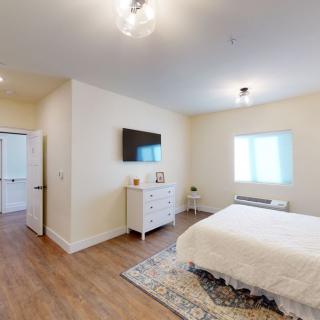
 Fully furnished
 Garden
 Housekeeping services
 Move-in coordination
 Outdoor space
 Telephone
 Wi-Fi/high-speed internet available
 Phoenix Sky Harbor International (19 miles away)
 24-hour supervision
 Activities of daily living assistance
 Assistance with bathing
 Assistance with dressing
 Assistance with transfers
 Diabetes diet
 Meal preparation and service
 Medication management
 Special dietary restrictions
 Transportation arrangement (medical)
 Transportation to doctors appointments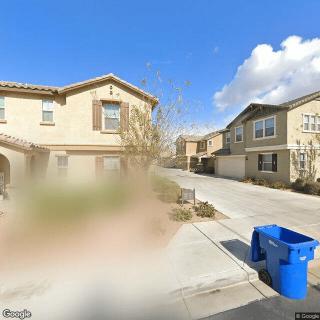





 Comprehensive Insights into Activities of Daily Living (ADLs) and Their Assessment
 Guiding Elderly Parents Who Refuse Assisted Living: 6 Practical Steps
 Your Comprehensive Guide to Luxury Assisted Living: Elevated Facilities, Amenities, and Costs