For more information about senior living options: (866) 208-4318
3.7 from 28 reviews
5 stars
11
4 stars
9
3 stars
0
2 stars
4
1 stars
4
Sunridge At Desert Springs Costs & Pricing
Sunridge At Desert Springs offers a competitive pricing structure for its accommodations, with both studio and semi-private room types priced at $3,600 per month. When compared to El Paso County, where studio rooms average around $3,115 and semi-private options are approximately $2,821, Sunridge's rates are notably higher. However, they remain relatively aligned with the broader Texas market, where studio units average $3,758 and semi-private rooms are around $3,680. This positioning suggests that residents at Sunridge At Desert Springs can expect to receive quality amenities and services that justify the premium in an otherwise varied regional landscape of assisted living costs.
Floor plans
Sunridge At Desert Springs
El Paso County
Texas
Studio
$3,600
$3,115
$3,758
Semi-Private
$3,600
$2,821
$3,680
Memory care communities with a similar price nearby
Many residents and families describe staff who are caring, knowledgeable, and quick to communicate concerns.
Several reviews highlight staff kindness and responsiveness, including nurses who are described as knowledgeable and attentive to changes. Families say medication is administered on time and that they are contacted when something needs attention. A few reviewers also mention how staff treat residents with respect and personalize interactions, which shows up in day-to-day experiences like meal support and greeting residents and visitors.
differentiator8 reviews mention this
Memory care helps with dementia
The reviews repeatedly connect the community with dementia support and memory care-specific handling.
Families mention dementia and Alzheimer’s directly, describing residents who appear more comfortable and engaged with staff support. One reviewer also notes the community’s memory care focus at tour time, and says the staff seemed knowledgeable and caring. At the same time, some families report mismatches between expectations for memory care expertise and how care played out in practice, especially around behavior redirection and supervision.
caveat7 reviews mention this
Management and supervision draw complaints
Some families report serious issues with management follow-through and day-to-day supervision.
A group of reviews describe care problems tied to supervision and leadership, including concerns about communication, cleanliness, and consistency of care. Families say residents were left in poor conditions at times, including issues such as not being bathed regularly and apartments not being kept clean. Several of these reviews also mention staff training and RN coverage as part of why problems were not resolved, along with accountability and follow-through gaps. One other review notes less oversight with complex medication and behavior needs.
common8 reviews mention this
Homelike setting and cleanliness stand out
Residents and families often mention the community’s home-like environment and cleanliness.
Positive comments describe a homelike, clean setting with bright common areas and a courtyard, along with residents kept in clean clothing. Some reviewers also emphasize how the facility looks, including a nicely furnished feel and a positive first impression during a visit or tour. On the other hand, a few reviews describe unacceptable cleanliness and odor-related concerns, including reports of issues with bathing frequency and general upkeep.
common4 reviews mention this
Dining feels social and supported
Dining is described as a social, staff-supported time in the community.
Multiple reviews refer to meals as part of daily life, including residents eating in shared spaces and staff checking in during mealtimes. One family mentions seeing residents in small groups at dinner and describes personal interactions there. A separate set of reviews contrasts this with complaints about care practices in or around the dining area, describing issues related to supervision and cleanliness. Another reviewer also recalls lunch being happening when visiting, reinforcing dining as a visible part of the setting.
How we summarize
Counts show how many written reviews mention each theme; a review can touch several themes, and only frequently mentioned themes are displayed.
Features
Housing
61 resident community capacity
Types of Care
Assisted Living
Memory Care
Amenities
Activities off-site
Activities on-site
Air-conditioning
Bath tubs
Beautician on-site
Beauty salon
Cable or satellite TV
Computer center
Devotional services off-site
Dining room
Fitness room
Fully furnished
Gaming room
Garden
Housekeeping services
Indoor common areas
Kitchenette
Move-in coordination
Outdoor common areas
Outdoor space
Private bathrooms
Respite or short term stays offered
Restaurant-style dining
Small library
Telephone
Wellness center
Wheelchair accessible showers
Wi-Fi/high-speed internet available
Transportation
El Paso International (9 miles away)
Community operated transportation
Transportation arrangement
Transportation arrangement (non-medical)
Transportation to doctors appointments
Care Services
12-16 hour nursing
24-hour call system
24-hour supervision
Activities of daily living assistance
Ambulatory care
Assistance with bathing
Assistance with dressing
Assistance with transfers
Diabetes diet
Diabetic care
Incontinence care
Meal preparation and service
Medication management
Mental wellness program
Mild cognitive impairment
Special dietary restrictions
Specialized memory care programming
Dining
Diabetes diet
Gluten-free
Guest meals
Low / no sodium
Meals provided
No Sugar
Professional chef
Restaurant style dining
Room service
Special dietary restrictions
Vegan
Activities
Art classes
Bible study group
Catholic services
Community-sponsored activities
Concierge services
Cooking classes
Day trips and outings
Devotional activities offsite
Fitness programs
Happy hour
Karaoke
Live dance or theater performances
Live musical performances
Live well programs
Planned day trips
Protestant services
Resident-run activities
Scheduled daily activities
Visiting chaplain or priest
Nearby Places of Interest
This part of El Paso, Texas offers a range of healthcare options, including physicians, pharmacies, and hospitals within a reasonable distance. The proximity to Mt West Family Health Center and Westside Family Medicine provides convenient access to primary care services, while specialty care is available at El Paso Pediatric Associates and Texas Tech Physicians of El Paso. In case of emergencies, Rio Vista Behavioral Health Hospital and Upper Valley Urgent Care Center are nearby. Additionally, there are several dining options such as Taco Bell, P.F. Chang's China Bistro, and L & J Cafe for a variety of culinary preferences. For leisure activities, residents can visit Crestmont Park or catch a movie at Cinemark. There are also cafes like Starbucks and District Coffee for socializing or enjoying a quiet moment alone. Overall, this area offers essential amenities and services that cater to the needs of seniors looking to reside in a convenient and accessible location in El Paso.
Physicians
Mt West Family Health Center (1.8 miles)
Westside Family Medicine (1.9 miles)
El Paso Pediatric Associates (2.2 miles)
Rio Vista Behavioral Health Hospital (3.7 miles)
Upper Valley Urgent Care Center (3.9 miles)
El Paso Cardiology Associates (4.1 miles)
Texas Tech Physicians of El Paso (4.3 miles)
Restaurants
Taco Bell (1.9 miles)
McDonald's (1.9 miles)
Thyme Matters (2.1 miles)
Whataburger (2.3 miles)
Chick-Fil-A (3.1 miles)
P.F. Chang's China Bistro (3.2 miles)
McDonald's (3.4 miles)
Pharmacies
Walgreens (1.9 miles)
Walgreens (2.2 miles)
Walgreens (3.7 miles)
CVS Pharmacy (5.4 miles)
Walgreens (5.5 miles)
Walgreens (5.9 miles)
Farmacias de Similares (6 miles)
Parks
Crestmont Park (2.7 miles)
Chihuahuita Park (7.5 miles)
Parque Chamizal (8.1 miles)
Theaters
Cinemark (3.1 miles)
Cafes
Teapioca Lounge (3.3 miles)
Starbucks (3.3 miles)
Starbucks (3.4 miles)
Dutch Bros Coffee (3.9 miles)
Starbucks (5.7 miles)
L & J Cafe (6.7 miles)
District Coffee (7 miles)
Hospitals
The Hospitals of Providence Transmountain Campus (4.3 miles)
Sunridge At Desert Springs offers a competitive pricing structure for its accommodations, with both studio and semi-private room types priced at $3,600 per month. When compared to El Paso County, where studio rooms average around $3,115 and semi-private options are approximately $2,821, Sunridge's rates are notably higher. However, they remain relatively aligned with the broader Texas market, where studio units average $3,758 and semi-private rooms are around $3,680. This positioning suggests that residents at Sunridge At Desert Springs can expect to receive quality amenities and services that justify the premium in an otherwise varied regional landscape of assisted living costs.
The features at Sunridge At Desert Springs are meticulously designed to support residents with varying stages of dementia and Alzheimer's disease, ensuring their safety and enhancing their quality of life. With 24-hour supervision, residents receive constant oversight, reducing the risk of wandering or accidents. Assistance with activities of daily living--such as bathing, dressing, and transfers--promotes dignity while aiding those who may struggle with these tasks independently. Incontinence care ensures comfort and hygiene, while meal preparation and service cater to dietary needs and preferences, encouraging nutrition. Medication management provides peace of mind that prescriptions are taken correctly. The mental wellness program addresses cognitive health through engaging activities tailored for mild cognitive impairment, fostering a sense of purpose. Finally, specialized memory care programming offers structured environments and stimulating interactions that help retain cognitive functions and enhance emotional well-being.
Nearby Communities
The Montevista at Coronado
El Paso, TX
4.4 from 154 reviews
$2,000 to $2,450 / month
Beautiful, well-kept community with spacious rooms, engaging activities, and strong dining.
El Parque Assisted Living Facility
El Paso, TX
5 from 1 review
$2,500 to $3,000 / month
Competitive, affordable pricing for semi-private and private rooms.
Oasis Foster Home
El Paso, TX
4.5 from 2 reviews
$2,500 / month
Affordable private room at $2,500/mo compared to local averages.
Ricci's Foster Home
El Paso, TX
Small, home-like setting with personalized care and 24-hour supervision plus medical coordination.
Pino Real Adult Foster Home
El Paso, TX
3.8 from 8 reviews
Small, personalized setting with 24/7 supervision and comprehensive care.
Amada Senior Care of El Paso, TX
El Paso, TX
5 from 22 reviews
Strong dedication to finding the right caregiver, including for remote locations.
Home Instead - El Paso, TX
El Paso, TX
4.5 from 41 reviews
Friendly, responsive staff and good value.
The Legacy at Cimarron
El Paso, TX
4.8 from 113 reviews
$3,295 to $4,225 / month
Exceptional staff with a hotel-like environment and engaging amenities.
Los Arcos Del Norte Care Center
El Paso, TX
4 from 93 reviews
Attentive staff meeting residents' needs; good dining and activities for seniors.
Caregiver support groups are crucial for providing emotional and practical assistance to those caring for loved ones, offering resources, coping strategies, and a sense of community through various organizations and platforms. These groups help alleviate isolation and burnout while addressing the unique challenges faced by caregivers of individuals with specific conditions.
The guide outlines the complexities of Medicaid coverage for assisted living, highlighting significant state-to-state variations, limited coverage often restricted to personal care services, and the existence of specialized waivers for certain needs like memory care. It advises families to consult local Medicaid offices for options while emphasizing the importance of understanding state-specific regulations and facility policies.
Medicaid coverage for assisted living varies by state and is primarily available to low-income individuals, with eligibility dependent on strict income and asset limits. Some states offer HCBS waivers for specific services in assisted living, but families must generally cover room and board costs, and should verify facility acceptance of Medicaid while considering potential waiting lists.
Get PricingAsk A QuestionSchedule A TourContact Senior Advisor
By clicking submit, you agree to our Partner's Terms of Use. You
also consent to receive calls and texts, which may be autodialed, from our Partner. Your consent is not a condition to
using our Partner's service. Please visit our Partner's Privacy Policy for information about their privacy practices.


 61 resident community capacity
 Assisted Living
 Memory Care
 Activities off-site
 Air-conditioning
 Bath tubs
 Beautician on-site
 Cable or satellite TV
 Computer center
 Devotional services off-site
 Dining room
 Fitness room
 Fully furnished
 Gaming room
 Garden
 Housekeeping services
 Indoor common areas
 Kitchenette
 Move-in coordination
 Outdoor common areas
 Private bathrooms
 Respite or short term stays offered
 Restaurant-style dining
 Small library
 Telephone
 Wellness center
 Wheelchair accessible showers
 Wi-Fi/high-speed internet available
 El Paso International (9 miles away)
 Community operated transportation
 12-16 hour nursing
 24-hour call system
 Ambulatory care
 Assistance with bathing
 Assistance with dressing
 Assistance with transfers
 Diabetes diet
 Diabetic care
 Incontinence care
 Medication management
 Mental wellness program
 Special dietary restrictions
 Art classes
 Bible study group
 Concierge services
 Cooking classes
 Day trips and outings
 Happy hour
 Karaoke
 Live dance or theater performances
 Live musical performances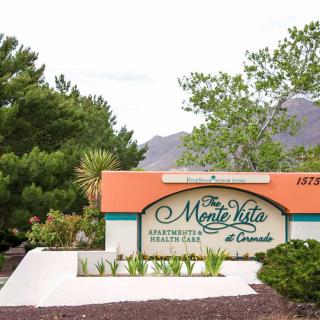
 Beautiful, well-kept community with spacious rooms, engaging activities, and strong dining.

 22 Remarkable Caregiver Support Groups Available Online and In-Person
 Understanding Medicaid Coverage for Assisted Living: A Comprehensive Guide
 How and When Medicaid May Cover Assisted Living Costs