
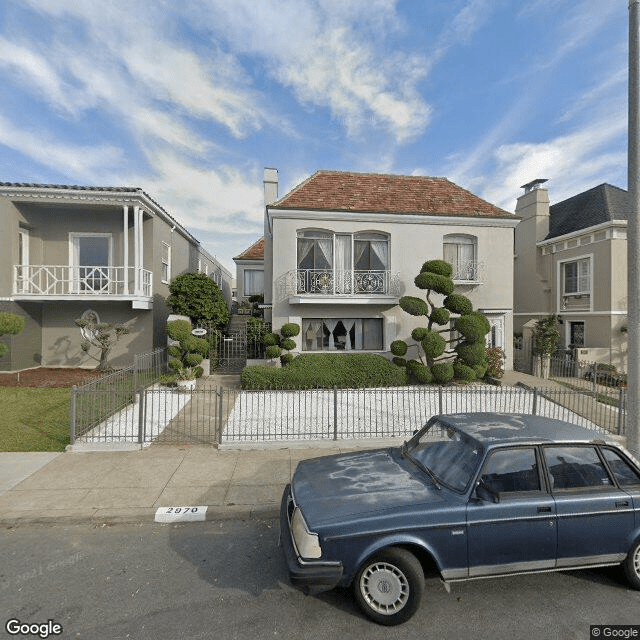
2970 25th Ave, San Francisco, CA 94132
To contact a resident: (415) 759-8137
For more information about senior living options: (866) 208-4318
Janet's Residential Facility Costs & Pricing
Janet's Residential Facility offers competitive pricing for its room types compared to the surrounding region. For a semi-private room, residents can expect to pay $2,800 per month, which is significantly lower than the average cost of $3,979 in San Francisco County and also more affordable than California's average of $3,333. Similarly, for a private room at Janet's, the monthly fee is set at $3,100, again undercutting San Francisco's typical rate of $3,591 and remaining below the statewide average of $3,939. These favorable rates make Janet's an appealing option for families seeking quality residential care while being mindful of their budget.
| Floor plans | Janet's Residential Facility | San Francisco County | California |
|---|---|---|---|
| Semi-Private | $2,800 | $3,979 | $3,333 |
| Private | $3,100 | $3,591 | $3,939 |
Senior living communities with a similar price nearby
-
from -$100 / mo

Home Instead Senior Care
$2,700 to $3,400 / month21.4 miles away -
from -$300 / mo
Ava Bella Care Home
$2,500 to $3,000 / month24.9 miles away -
from +$395 / mo
Harbor Bay Assisted Living
$3,195 to $5,000 / month12.6 miles away -
from +$200 / mo
Eden Assisted Living
$3,000 / month21.0 miles away -
from -$300 / mo

San Carlos Elms
$2,500 to $5,880 / month19.9 miles away
Overall Review of Janet's Residential Facility
Pros
 The staff provided excellent care for the reviewer’s father-in-law for several years.
- The services offered great value.
Review
Janet's Residential Facility in San Francisco is best suited for families who prioritize highly attentive, consistent caregiving and strong value over a broad menu of upscale services. The sole available review emphasizes that staff delivered excellent care for a relative over several years, implying reliability, continuity, and a steady caregiving presence. For families weighing options, this combination, personal day-to-day attention paired with a price point that supports long-term support, often makes the difference when stability is the primary objective. The emphasis here is on dependable care, not on polished marketing illusions; care quality and affordability take precedence.
Those who may want to consider alternatives are likely families with residents who require intensive medical oversight, memory-specific programming, or a wider spectrum of on-site services and social activities. The single review does not reveal how complex medical needs are managed, how medication regimens are coordinated, or how emergency responses are handled. For residents needing frequent clinician access or specialized therapies, other communities may offer larger care teams, structured care plans, and more developed programming. In such cases, the trade-off for a bit more comfort and variety may be worth sacrificing some everyday familiarity and affordability.
Key positives from the review center on care quality and value. The staff’s long-term, high-quality attention translates into dependable daily supervision, familiarity with individual routines, and a solid foundation for safety. When costs are a major consideration, the claim of “great value” becomes a meaningful differentiator, enabling families to sustain caregiving support over years without an escalating bill. This value proposition does not come at the expense of essential respect and responsiveness; instead, it foregrounds steadiness and trust, attributes that can markedly reduce stress for family members juggling work, caregiving, and emotional worry.
These strengths offset potential downsides by placing care consistency at the center of the experience. In smaller settings where staff know residents and can recognize subtle changes quickly, the absence of flashy amenities is less consequential. The trade-off is clear: fewer on-site programs or luxury touches, but with a higher likelihood of timely check-ins, personalized reminders, and sheltered routines. For families prioritizing continuous monitoring and a predictable day-to-day rhythm, this balance often proves more protective than larger facilities that may offer more activity but less individual attention.
Nevertheless, the lack of broader feedback means caution is warranted. Without multiple resident voices, gap areas such as social engagement, dining variety, or transportation options remain uncertain. Prospective newcomers should pursue concrete questions: what are staffing ratios and shift patterns, is 24/7 coverage assured, how are meals prepared and modified for dietary needs, and what is the process for updating care plans? Verifying licensure status, inspection results, and the ability to scale care in response to changing needs will sharpen the decision.
Overall, Janet's Residential Facility appears well-suited for families prioritizing compassionate, stable caregiving combined with clear value. For those seeking a larger clinical footprint, extensive memory-care programming, or a broader activity calendar, alternatives deserve consideration. The prudent course is to visit, observe care interactions, and probe directly into daily routines, medication management, and emergency readiness. If alignment is found, this community can deliver trustworthy, long-term support at a reasonable cost; if not, continue the search with a defined set of must-haves to avoid premature commitments.
 Board and Care Home
 Private
 San Francisco International (10 miles away)
 Effective Strategies for Keeping Seniors' Minds Active: A Deep Dive into Brain Games and Apps
 In-Depth Look at the VA Aid and Attendance Program
 Nurturing Our Loved Ones: A Daughter's Journey in Caring for Her Mother