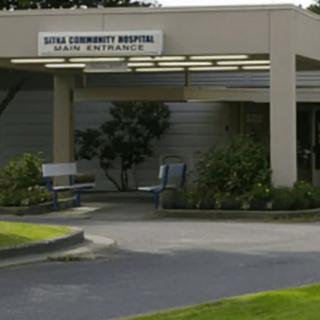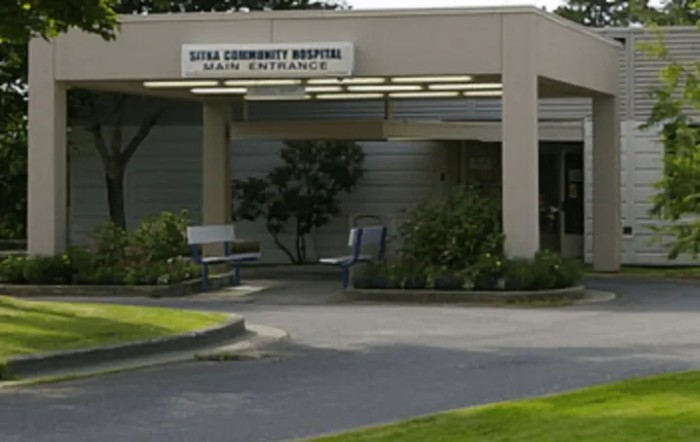


209 Moller Avenue, Sitka, AK 99835
For more information about senior living options: (866) 208-4318
Overall Review of Sitka Community Hospital - Long Term Care Unit
Pros
 The doctors and nurses here are wonderful.
- The hospital is pretty good, being one of only two on the island.
- The hospital saved the patient's eyes.
Cons
 Social services is a joke.
- The lady is absolutely disrespectful and rude.
- Searhc Patient Housing has bed bugs.
- Searhc Patient Housing should be closed immediately and exterminators should be brought in.
- Patients are not going to get a good night’s rest because of bed bugs.
- There is concern that the facility will ignore the bed bug problem and not act promptly.
Review
Sitka Community Hospital’s Long Term Care Unit is best suited for seniors who require steady medical oversight and value immediate, hospital-adjacent access to care in a remote island setting. The unit functions as a practical, no-nonsense option for residents whose health needs can be stabilized and monitored on-site, with the assurance that acute changes can be escalated quickly given the hospital affiliation. For families, the key advantage lies in continuity of care: a medically capable team, quick nurse and physician availability, and the comfort of knowing that a nearby hospital can handle emergencies or complex conditions without lengthy transfers. In short, this unit serves medically complex residents who prioritize safety, prompt clinical response, and direct links to acute services over a more expansive social or lifestyle-oriented care environment.
Who may want to consider alternatives? Those who prioritize a warm, person-centered culture with consistently respectful social services support may find the experience uneven here. Several reviews flag social services as a troublesome point, describing interactions as disrespectful and unhelpful, which can complicate discharge planning, transportation coordination, and care transitions. Additionally, cleanliness and maintenance concerns surface in the feedback, with warnings about bed bug issues in housing areas used by patients. For families seeking robust social engagement, memory-care enrichment, or a broader range of resident-focused programs, these factors can weigh heavily. Residents who value a plush setting, predictable social programming, and a highly supportive on-site care coordination culture should rightly consider alternatives.
The strongest positives, the clinical core, partly offset the most troubling cons. The doctors and nurses are repeatedly described as wonderful, capable, and attentive, which matters tremendously for seniors who rely on steady medical judgment and timely interventions. Being one of only two hospitals on the island adds a practical reliability: access to hospital-level resources, specialists, and imaging or procedures without long travel. This medical acuity and proximity to acute care can translate into better outcomes for conditions that require ongoing management, and it provides reassurance to families that a crisis won’t necessitate a distant, uncertain transfer. When health stability is the priority, those clinical strengths offer a meaningful counterweight to the friction in other areas.
Yet the drawbacks cannot be dismissed. Social services interaction quality directly impacts the overall experience, particularly for families navigating discharge timelines, home-care arrangements, or transportation logistics. A responsive, respectful social-work process is essential to smooth transitions and to ensuring that goals of care align with what the resident will experience after leaving the facility. The reported pest issue in patient housing raises legitimate concerns about cleanliness, routine maintenance, and infection-control vigilance. Even with strong medical staff, compromised environment and uneven administrative support can erode confidence over time, especially for families managing multiple health needs or long-term care plans.
Ultimately, this community is a strong choice for medically fragile residents who need reliable monitoring and rapid access to hospital services, and for families who can live with variable social support and potential housing maintenance hurdles. The decision hinges on prioritizing medical stability over social experience and environmental polish. If those trade-offs feel acceptable, Sitka Community Hospital LTC stands as a practical, capable option in a remote Alaska setting. If, however, the aim is consistent, respectful social work, a consistently clean housing environment, and a richer resident-centered culture, it would be wise to explore alternatives that emphasize those elements more comprehensively. In such a scenario, roots in a facility with stronger social services teams and a proven track record of pest-free housing should shape the final choice.
 15 resident community capacity
 Skilled Nursing Facility
 Cable or satellite TV
 Dining room
 Fully furnished
 Garden
 Housekeeping services
 Move-in coordination
 Outdoor space
 Telephone
 Wi-Fi/high-speed internet available
 Sitka (1 miles away)
 24-hour supervision
 Activities of daily living assistance
 Assistance with bathing
 Assistance with dressing
 Assistance with transfers
 Diabetes diet
 Meal preparation and service
 Medication management
 Special dietary restrictions

 Exploring the World of Home Health Nurses: Qualifications, Roles, and Hiring Tips
 Navigating Medicare Coverage for In-Home Care Services
 In-Home Care Costs in 2025: A Detailed State-by-State Exploration