
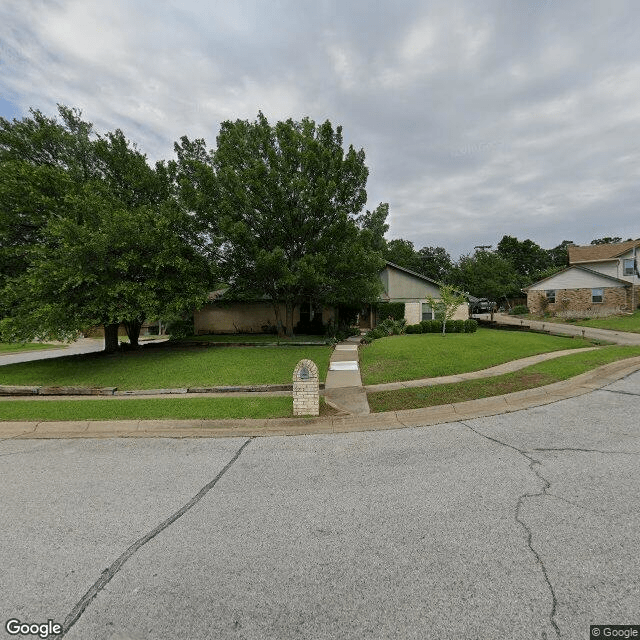
603 Bent Tree Court, Euless, TX 76039
To contact a resident: (972) 679-0431
For more information about senior living options: (866) 208-4318
Unlimited Care Costs & Pricing
Unlimited Care offers competitive pricing for its services compared to the broader market in Tarrant County and the state of Texas. For a semi-private room, Unlimited Care's monthly fee is $2,850, which is significantly lower than the average cost of $3,889 in Tarrant County and $3,680 across Texas. Similarly, for private rooms, Unlimited Care charges $3,300, again more affordable than the local and state averages of $3,704 and $4,096 respectively. This pricing structure reflects Unlimited Care's commitment to providing accessible and high-quality care options while remaining economically attractive to families seeking support for their loved ones.
| Floor plans | Unlimited Care | Tarrant County | Texas |
|---|---|---|---|
| Semi-Private | $2,850 | $3,889 | $3,680 |
| Private | $3,300 | $3,704 | $4,096 |
Senior living communities with a similar price nearby
-
from +$550 / mo

Highlands Village Senior Living of Mansfield
$3,400 to $4,695 / month20.7 miles away -
from +$500 / mo
Sparks Assisted Living
$3,350 to $4,250 / month10.4 miles away -
from +$150 / mo
My Family Care Home I
$3,000 to $3,500 / month15.2 miles away -
from +$150 / mo
Residential Care
$3,000 / month21.7 miles away -
from -$355 / mo

Lewisville Estates - IL
$2,495 to $3,295 / month13.7 miles away
Overall Review of Unlimited Care
Pros
 They provide in-home care for adults 18 years and older.
- They are state licensed, bonded, and carry extensive insurance.
- They are locally owned for 21 years.
- The staff is caring, skilled, and dedicated.
Review
Unlimited Care in Euless is best suited for adults 18 and older who want professional, licensed in-home care delivered with continuity and a local touch. The agency operates as a state-licensed, bonded provider with substantial insurance coverage, offering the reassurance that care is governed by formal standards rather than ad hoc arrangements. With 21 years of local ownership, the organization prioritizes familiarity, accountability, and a stable caregiver pool. For families who value receiving care in the familiar surroundings of home while still accessing trained, caring professionals, Unlimited Care stands out as the practical, low-disruption option.
Those who may want to consider alternatives are precisely the ones who expect a more social, campus-style environment or require round-the-clock supervision with immediate access to on-site medical support. If the goal is a highly structured community life, abundant group activities, or specialized memory care or skilled nursing services under one roof, a traditional assisted living, memory care, or skilled nursing facility will usually be a better fit. In-home care can fall short on built-in social opportunities and the level of continuous supervision some situations demand.
The strongest advantages lie in licensure, bonding, and robust insurance, coupled with a long-standing local presence. These factors translate into clear accountability and reduced risk for families navigating caregiver selection and billing. The caretaking staff is described as caring, skilled, and dedicated, which directly supports trust and consistency, two critical elements for anyone balancing safety, independence, and comfort at home. The local ownership and twenty-one-year track record further bolster confidence that caregiver turnover is manageable and that the agency understands the community’s unique needs.
These advantages, however, come with trade-offs that families should weigh carefully. In-home care inherently limits access to a social ecosystem and around-the-clock on-site supervision that a facility provides. If the priority is a 24/7 staffed environment with immediate access to on-site healthcare resources and scheduled social programming, an alternative setting may offset that gap more effectively than any home-based arrangement. The absence of explicit drawbacks in the available information does not erase these inherent differences; the question is how well the home-care model aligns with the individual’s daily realities and safety requirements.
To make a well-supported decision, prospective clients should verify a few practical details. Confirm the scope of services compatible with adults 18 and older, including levels of medical oversight, caregiver training standards, and back-up coverage when primary staff are unavailable. Inquire about caregiver-to-client ratios, background and reference checks, and how care plans are developed and updated. Ask for transparent pricing structures, billing practices, and what elements are included in respite options. Most importantly, request a plan for continuity of care, how care is coordinated if a caregiver changes shifts or if a client’s condition evolves, so the benefits of a stable, committed team are realized rather than overridden by administrative gaps.
Bottom line: Unlimited Care is a pragmatic, solid choice for families seeking dependable in-home care with licensed safeguards, robust insurance, and a locally anchored operator who has stayed the course for over two decades. It is a particularly strong match for those who value the comfort of home and the assurance of skilled, compassionate staff. For families prioritizing a vibrant community setting, comprehensive on-site medical oversight, or intensive 24/7 supervision, exploring facility-based options remains advisable. The best decision hinges on balancing the core strengths of home-based care with the specific needs and social expectations of the individual involved.
 Board and Care Home
 Activities on-site
 Bath tubs
 Indoor common areas
 Outdoor common areas
 Private
 Private bathrooms
 Respite or short term stays offered
 Wheelchair accessible showers
 Dallas-Fort Worth International (4 miles away)
 Ambulatory care
 Diabetic care
 High acuity care
 Incontinence care
 Meals provided




 Nurturing Our Elders: Linda's Journey of Supporting Her Mother
 A Comprehensive Exploration of Common Misunderstandings about Powers of Attorney
 Senior Move Management: Understanding the Role, Value, and Associated Costs